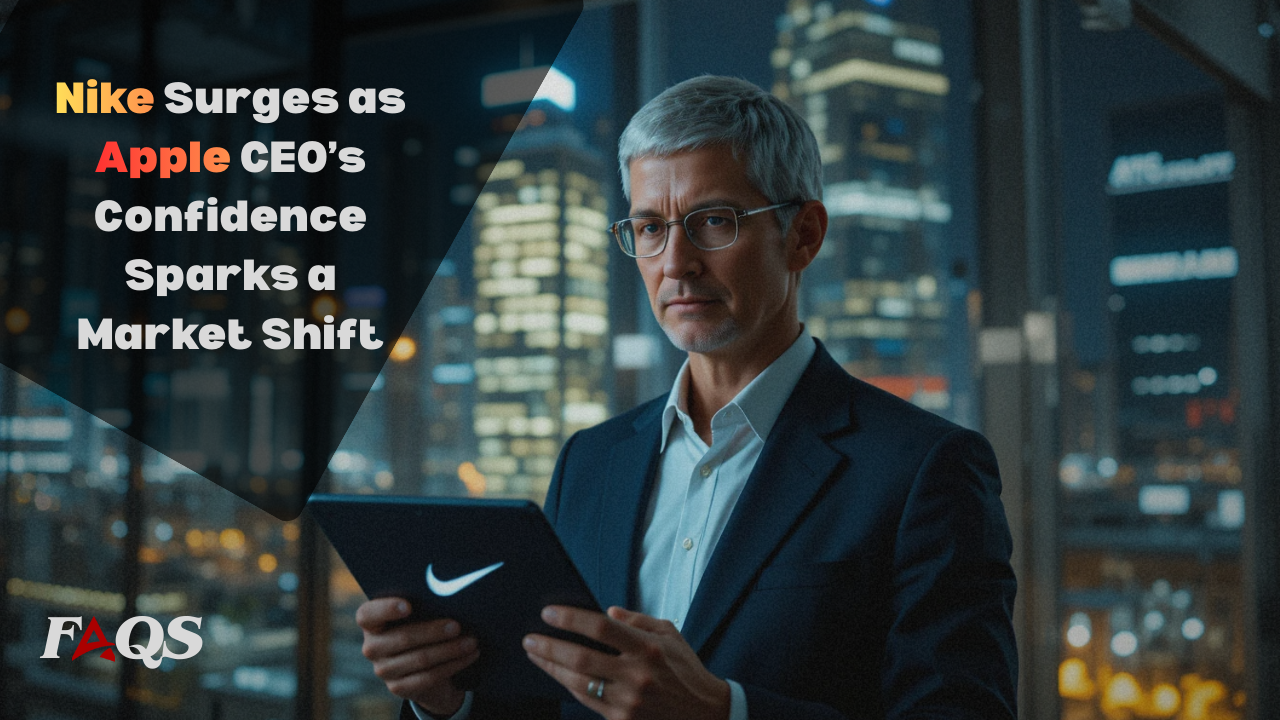
Nike, the Dow, and a CEO’s Conviction, Inside the Trade That Changed Market Mood
Financial markets are often portrayed as cold, mathematical systems machines driven by data, algorithms, and forecasts.
But moments like this reveal a deeper truth:
Markets still listen to people.
When news broke that Apple CEO Tim Cook purchased nearly $3 million worth of Nike shares, stepping in after the company’s post-earnings decline, the reaction was swift.
Nike stock jumped.
The Dow Jones Industrial Average rose.
Sentiment shifted.

This was not a routine insider purchase.
It was a signal from one of the most trusted corporate leaders in the world.
The Market Backdrop Why Sentiment Was Fragile
Nike’s earnings report had rattled investors.
Concerns centered on
- slowing consumer demand in key regions
- inventory normalization challenges
- margin pressure in a competitive retail environment
None of these issues were existential but together they created uncertainty, the one thing markets dislike most.
As selling pressure mounted, Nike’s valuation reset rapidly, opening the door for conviction capital.
Tim Cook and Nike A Relationship Built Over Decades
Tim Cook’s decision did not come from the sidelines.

His history with Nike includes
- long service on Nike’s board of directors
- close familiarity with its leadership, strategy, and supply chain
- deep insight into how global brands navigate cyclical downturns
This context matters.
When Cook buys Nike stock, he does so not as a speculative trader but as someone who understands the difference between structural weakness and cyclical pressure.
Why This Purchase Was So Powerful
Markets distinguish between
Cook’s purchase fell squarely into the second category.
Investors interpreted the move as
- confidence that the earnings dip was temporary
- belief that Nike’s brand equity remains intact
- reassurance that long-term fundamentals outweigh short-term noise
This is why Nike’s shares didn’t just stabilize they jumped.
The Dow’s Rise How One Stock Lifted the Mood
The Dow’s gain was not mechanically driven by Nike alone.
Instead, Nike’s rally acted as a psychological catalyst.
It reminded investors that
- blue-chip companies still attract belief
- leadership confidence can anchor markets
- selloffs are not always signals of decline
Once confidence returns, capital follows.
A Historical Pattern When Executives Buy the Dip
This moment fits a familiar market pattern.
Historically
- insider buying after earnings drops often marks sentiment bottoms
- purchases by respected executives amplify confidence
- markets respond more strongly to who buys than how much they buy
Tim Cook’s name carries exceptional weight making the signal louder than the dollar amount.
Nike’s Long-Term Identity Why the Brand Still Matters
Despite near-term challenges, Nike remains
- a dominant global sportswear brand
- culturally embedded across generations
- diversified across footwear, apparel, and digital ecosystems
Short-term pressure does not erase
- decades of brand equity
- global distribution strength
- pricing power over the long cycle
Cook’s move suggests faith in that durability.
What This Moment Does Not Guarantee
It’s critical to maintain perspective.
This purchase does not ensure
- immediate earnings recovery
- smooth macro conditions
- immunity from competition
It does suggest that
- valuation fear exceeded business reality
- long-term confidence still exists among insiders
 ltas Opinion
At Altas, we interpret this episode as a reminder that markets are human systems.

1. Leadership Still Shapes Markets
Algorithms dominate volume but trust shapes direction.
2. Conviction Matters More Than Timing
Cook didn’t buy at the lowest tick he bought with intent.
3. Nike’s Problem Is Cyclical, Not Structural
Demand cycles change. Brands endure.
Altas Editorial Verdict
Tim Cook’s Nike purchase didn’t solve Nike’s challenges.
What it did was reframe the narrative.
From panic to perspective.
From fear to patience.
From selling to watching.
In modern markets, that shift alone is powerful.
Broader Lessons for Investors
This episode reinforces key principles
- follow leadership actions, not just headlines
- separate earnings volatility from brand erosion
- recognize sentiment inflection points
Markets often turn before fundamentals visibly improve.
FAQs
Q1: Why did this purchase matter more than analyst upgrades?
Altas Answer: Analysts interpret data; executives act on knowledge.
Q2: Does this suggest Nike stock was undervalued?
Altas Answer: It suggests valuation fell faster than confidence.
Q3: Could other executives follow with similar buys?
Altas Answer: Possibly but few carry Cook’s signaling power.
Q4: Should investors copy CEO trades blindly?
Altas Answer: No use them as context, not instructions.
Q5: Is this kind of signal becoming rarer?
Altas Answer: Yes, which is why markets react strongly when it appears.
Table of Contents
- Iran War 2026 What Happened and Why Is It Important?
- Helldivers 2 Ultimate Survival Guide: Best Weapons, Builds, Missions & Pro Tips (2026)
- The PlayStation 6 – Everything Gamers Have Been Waiting For – Specs, Power, Features, and the Future of PS Gaming
- Global Crisis 2026 – The New World Order? How Nations Are Reshaping Global Power and Economy- What Happens After the Dollar Era?
- The Witcher 3: Wild Hunt – The Fantasy Masterpiece That Redefined Open-World RPGs

KOORUI 24 Inch Gaming Monitor
| Brand | KOORUI |
| Screen Size | 24 Inches |
| Resolution | FHD 1080p |
| Aspect Ratio | 16:9 |
| Screen Surface Description | Matte |
Leave a Reply