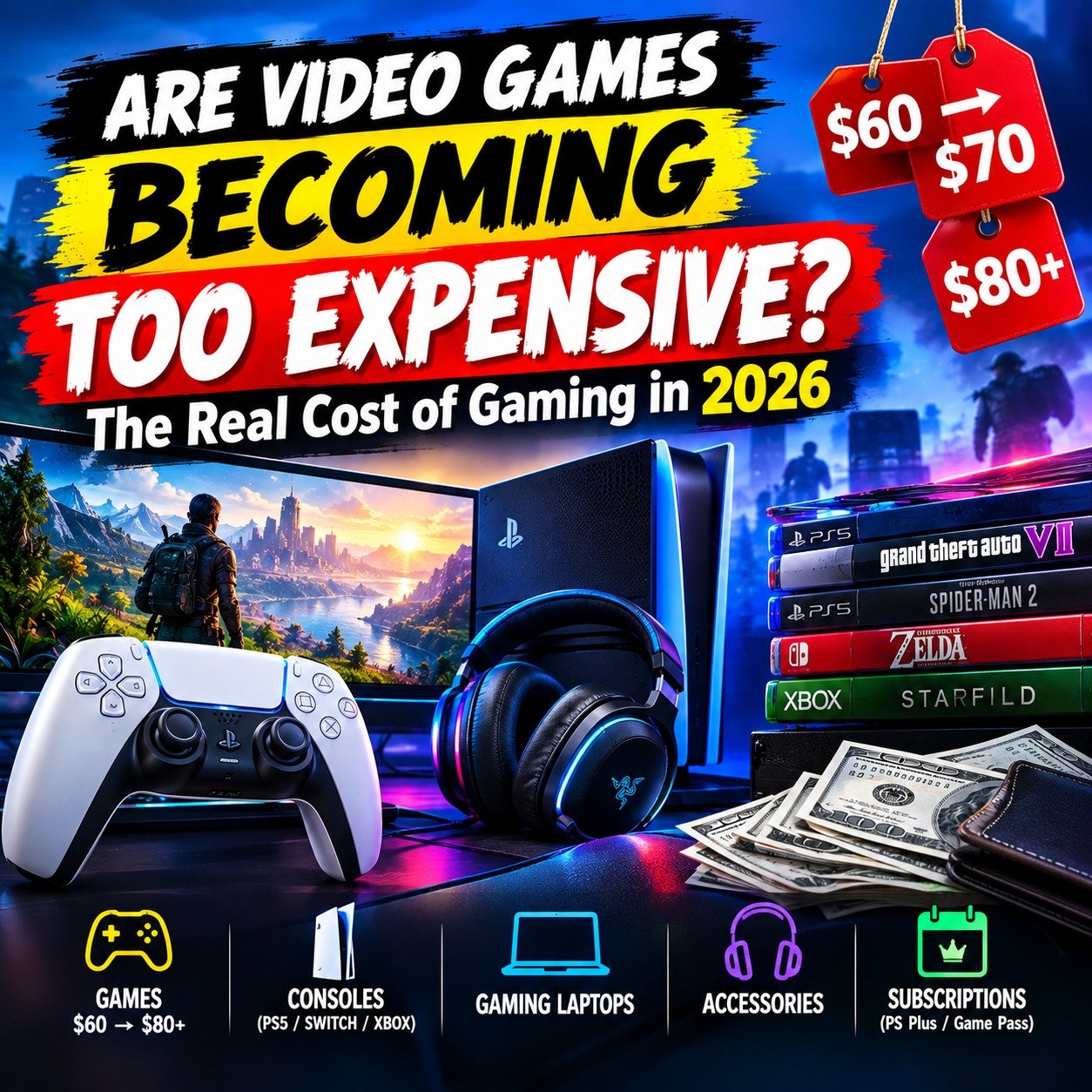
Buying a new video game used to feel like a major purchase, but for many gamers, the price of new releases is becoming harder to ignore. Premium games that once commonly launched around $60 are now frequently priced at $70, while some major releases have reached $80 or more.
In 2026, this conversation has become even more important. Games such as Grand Theft Auto VI are launching at $79.99 in the United States, while Nintendo has also moved some Switch 2 titles to an $80 price point. At the same time, gaming hardware, accessories and subscriptions can add hundreds of dollars to the overall cost of being a gamer.
But does that mean video games are actually becoming too expensive?
The answer depends on what you compare them with, how often you buy games and what you expect from a modern release.
Why Are New Games So Expensive?
One of the biggest reasons behind higher game prices is the increasing cost and complexity of game development.
Modern AAA games can require hundreds of developers working across programming, animation, sound design, writing, motion capture, testing, online infrastructure and marketing. Games are also expected to support increasingly detailed graphics, larger worlds and more features.
Publishers therefore have to recover enormous development and marketing investments. Raising the launch price is one way to increase revenue from the players who are willing to buy immediately.
However, higher development costs do not automatically mean every game should cost $80. The market is becoming more complicated, with games available at many different price points.
Industry research from Boston Consulting Group found that gamers are increasingly using discounts to manage their spending. Around 65% of surveyed gamers said they use tactics such as waiting for sales, while about 30% said they would reduce their game purchases if prices increased.
The $60 to $70 to $80 Evolution
For years, $59.99 was the standard price for many major console games in the United States.
That changed as publishers gradually moved premium releases toward $69.99. Today, $69.99 is still common for major games, but $79.99 is becoming increasingly visible.
The official PlayStation Store, for example, currently lists many major PS5 releases at $69.99, while some upcoming titles are already listed at higher prices. Grand Theft Auto VI is currently listed for preorder at $79.99.
Nintendo has also entered the $80 conversation with Switch 2 software. Nintendo explained that starting in 2026, new Nintendo-published digital titles exclusive to Switch 2 can have different MSRPs from physical versions.
This does not mean every game is suddenly $80. Instead, the industry is moving toward a wider pricing structure where some premium releases cost significantly more than others.
Is $80 Really That Expensive?
An $80 video game sounds expensive, especially when compared with older games.
But there is another way to look at it.
A movie ticket might cost around $10 to $20 depending on the location and theater. After two or three hours, the experience is over. A large single-player game can provide 30, 50 or even 100 hours of entertainment.
If you spend $80 on a game and play it for 40 hours, the cost works out to around $2 per hour.
That does not make $80 affordable for everyone, but it shows why comparing the purchase price alone can be misleading.
BCG’s 2026 gaming report found that premium games can offer lower entertainment costs per hour than movies and other forms of video entertainment. The report estimated that gaming can be 30% to 80% cheaper on a cost-per-hour basis.
The problem is that gamers do not buy games based only on hours of entertainment. They also have to consider their monthly budget and the fact that they may want to buy several games each year.
The Real Problem May Be Buying Too Many Games
For some gamers, the problem is not that one game costs $70 or $80.
It is that there are too many games to buy.
Major releases arrive throughout the year, while indie games, expansions, remasters and live-service titles compete for the same wallet.
Imagine buying one $70 game every month. That is $840 per year before taxes or additional downloadable content.
Add a console, gaming headset, controller, monitor and subscription service, and the total cost of gaming can become significant.
This is why discounts have become such an important part of gaming culture. Many players simply stop buying games at launch and wait for a sale.
Waiting a few months can sometimes turn a $70 purchase into a $40 or $30 purchase, while older games can fall even further in price.
Are Games Actually More Expensive After Inflation?
This is where the argument becomes more complicated.
A $60 game from years ago is not worth the same amount in today’s money because of inflation.
BCG’s gaming research found that premium game prices have actually declined on an inflation-adjusted basis over the past two decades. In other words, although the sticker price has increased, the real cost relative to inflation has not necessarily increased at the same rate.
This is an important point that often gets lost in the discussion.
A gamer might remember buying games for $60 and think today’s $70 or $80 price represents a huge increase. But the purchasing power of $60 has changed over time.
That does not mean $80 games are cheap. It simply means the historical comparison is more complicated than looking at the numbers printed on the box.
The Bigger Issue: Extra Costs After Buying the Game
One reason modern gaming can feel more expensive is that the initial game price may not be the end of the spending.
Some games have deluxe editions, season passes, cosmetic items, expansions and other optional purchases.
A player might pay $70 for a base game and then spend another $20, $30 or $40 on additional content.
Live-service games can go even further, with regular cosmetic releases and seasonal content encouraging players to keep spending.
Not every game follows this model, and optional content can provide additional value when it is genuinely substantial. However, gamers can understandably feel frustrated when a full-price game also contains a large number of additional purchases.
The difference between paying $70 once and gradually spending $100 or more on the same game can be significant.
Subscriptions Are Changing How People Buy Games
Another major change is the growth of gaming subscriptions.
Services such as PlayStation Plus and Xbox Game Pass allow players to access large libraries without buying every game individually.
For someone who plays many different games, a subscription can potentially provide more value than purchasing every title at launch.
However, subscriptions also change the relationship between gamers and the games they play. Instead of owning every game permanently, players may access games for as long as those titles remain available through the service.
This creates a choice.
Would you rather pay $70 or $80 for a game you know you want to own, or pay a monthly fee to access a large library?
There is no universal answer. It depends on how frequently you play and whether the games you want are included.
Physical Games Can Still Help Gamers Save Money
Physical games can offer another way to control gaming costs.
When you buy a physical copy, you may be able to find discounts at retailers, purchase used copies or resell the game after finishing it.
Digital games are convenient, but digital purchases generally cannot be resold in the same way.
This can make physical gaming particularly attractive for players who regularly buy and sell games.
However, the industry is increasingly moving toward digital distribution. That makes price competition and consumer choice an important part of the discussion around future game pricing.
The shift toward digital also means gamers need to pay closer attention to sales, regional pricing and subscription options when deciding how to buy.
Are $80 Games Worth It?
This depends entirely on the game.
If a game provides a polished 50-hour single-player campaign, strong replayability and a quality experience without forcing players to spend more, some gamers may consider $80 reasonable.
For another player, $80 may be too much regardless of the game’s quality.
The biggest problem is paying premium prices for games that do not deliver a premium experience.
A game can have an enormous budget and still launch with bugs, performance problems or missing features. When players spend $70 or $80, their expectations naturally become higher.
The higher the price, the less patience consumers may have for unfinished or poorly optimized releases.
That is one reason reviews, gameplay demonstrations and post-launch updates have become increasingly important before making a purchase.
Smaller Games Are Offering Another Option
The gaming industry is not only about expensive AAA releases.
Indie games and smaller AA titles can offer excellent experiences at much lower prices.
Some critically acclaimed games launch at $30, $40 or $50 rather than $70 or $80. These games may not have the same graphical scale as the biggest AAA productions, but they can still offer original ideas, strong storytelling and hundreds of hours of replayability.
BCG’s gaming research highlighted this broader pricing trend, noting that the market is becoming more divided across different price points rather than relying on one standard premium price.
This is good news for gamers.
You do not necessarily need to spend $80 every time you want something new to play.
How Gamers Can Spend Less
The easiest way to reduce gaming costs is to stop feeling pressured to buy every major release at launch.
Waiting for a sale can save a significant amount of money. Many games also receive discounts relatively quickly after release.
Another strategy is to maintain a backlog.
Instead of buying a new game every time something interesting launches, finish the games you already own first. This can save money while also helping you get more value from previous purchases.
Subscriptions can also make sense for players who regularly try different games.
Finally, consider indie and older games. Some of the best gaming experiences are not necessarily the newest or most expensive releases.
So, Are Video Games Becoming Too Expensive?
The answer is complicated.
Yes, gaming can feel more expensive, especially when premium releases reach $80 and players also have to pay for consoles, accessories, subscriptions and additional content.
At the same time, the industry has more ways to play than ever before. Free-to-play games, subscriptions, discounts, used physical games, indie titles and older releases give players alternatives to buying every AAA game at launch.
There is also evidence that games can provide significant entertainment value relative to their cost, particularly when a player spends dozens of hours with a single title.
The real question may not be whether all video games are too expensive.
It may be whether every new game deserves a premium launch price.
Final Thoughts
The $70 and $80 price tags are likely to remain an important part of the gaming industry, especially for major AAA releases. Grand Theft Auto VI and higher-priced Switch 2 games show that publishers are willing to test what consumers will pay.
But gamers still have choices.
You can wait for discounts, use subscriptions, buy physical copies, explore indie games or simply skip releases that do not offer enough value.
For players, the best approach is not necessarily to stop buying expensive games altogether. It is to become more selective.
A game being expensive does not automatically make it bad value. But a high price should come with high expectations.
Table of Contents

Leave a Reply