


More game developers are using AI than ever, and more of them dislike it than ever. That is the headline finding of GDC’s latest State of the Game Industry report, released on November 12, 2026, and based on more than 2,600 professionals across 69 countries.
According to the report, 40% of game industry professionals now use generative AI at work, up from 36% in the previous survey. At the same time, 55% say it is hurting the industry, 35% call its impact mixed, and only 8% call it positive.
This matters for players because AI in gaming is no longer a lab experiment. It now shapes the voices you hear, the teammates you play alongside, the graphics on your PC and the way studios plan budgets and schedules.
What Happened?
The GDC Festival of Gaming, the organisation behind the Game Developers Conference, published its November 2026 industry report. The report now releases near the end of the year rather than at the start.
AI use depends heavily on the kind of studio. Usage stood at 70% at mobile-only studios, 58% at free-to-play developers, 39% at premium game developers and 29% at indie developers.
It also depends on the job. 63% of business operations and services workers use generative AI, compared with 51% of marketing and PR staff and 48% of programmers.
Earlier in the year, at GDC 2026 in San Francisco (March 9–13), NVIDIA used the event to showcase RTX neural rendering and AI tools for developers. Google Cloud, Krafton and others also presented AI-related gaming projects.
How Game Developers Are Using AI
Most developers who use AI are not using it to build the parts of a game that players see. Among adopters, nearly three-quarters use it for research and brainstorming, 56% for code generation and debugging, 22% for concept art and visual ideation, and just 7% for player-facing features. 57% of adopters use it daily.
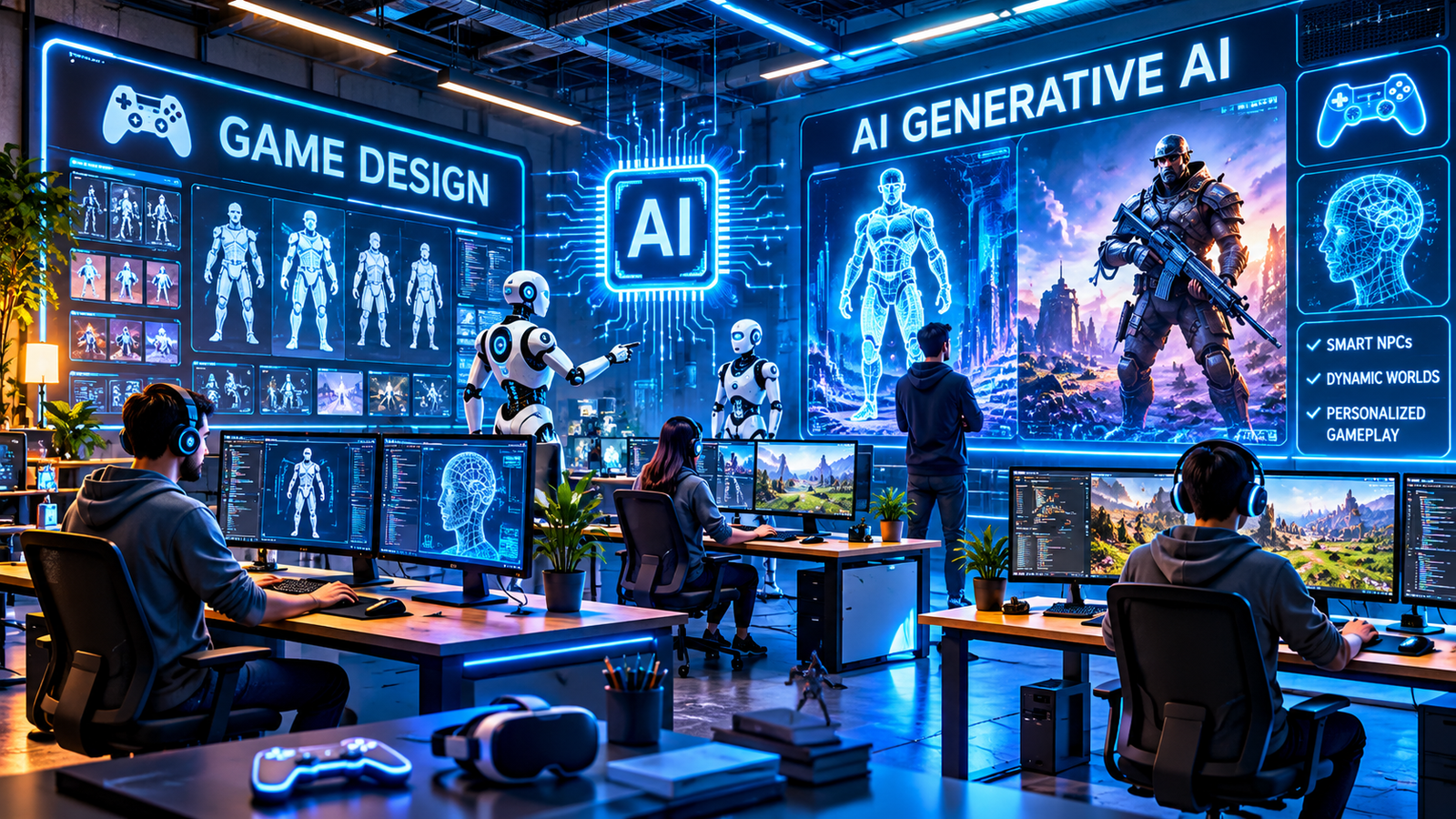
In practice, AI is showing up in five main areas:
- Concept art and prototyping: exploring early ideas for characters, environments and level layouts before final assets are made.
- Coding assistance: writing functions, explaining errors and speeding up repetitive programming work.
- Quality assurance (QA): repeating the same test inputs and sequences many times to find bugs.
- Rendering and graphics: AI-powered upscaling and neural rendering on PC.
- Voice and dialogue: generating or expanding voice lines, the most controversial use.
Japanese studio Team Ninja (Koei Tecmo), maker of Nioh and Wo Long, is a good example of the QA approach. At G-CON 2026, producers Kohei Shibata and Masakazu Hirayama said the studio already uses AI for quality assurance and verification tasks, but that human judgement is still essential to make action gameplay feel thrilling.
Studio rules vary widely. Across all GDC respondents, 23% say AI is banned at their studio, 11% say it is discouraged, 17% say it is encouraged, 12% can use it at their discretion and 1% are required to use it.
There is a clear gap between big and small studios. 27% of AAA workers feel encouraged or pressured to use generative AI, compared with 9% at indie studios. (AAA means big-budget games from major publishers.)
What Has Changed?
Before: GDC’s January 2026 report surveyed more than 2,300 professionals. It found 36% used generative AI, and 52% said it was having a negative impact on the industry. That negative figure was 30% the year before and just 18% two years earlier.

Now: Use has risen to 40%, and negative sentiment has climbed to 55%, the highest level so far. Even so, Game Developer reported that professionals show more openness to select uses of AI, while creative and player-facing content remain largely off the table.
The three-year trend is consistent: more developers are trying AI, and more of them are worried about where it is heading.
Will AI Replace Game Developers?
This is the industry’s biggest fear. In the November survey, respondents pointed to creativity and job losses as key concerns. The report also warned about “skill atrophy”, meaning developers may lose skills if AI does too much of the work for them.
The timing makes the fear stronger. GDC’s January report found 28% of professionals had been laid off in the previous two years.
Junior roles are the most exposed. If AI lets smaller teams do work that once needed more people, entry-level jobs in art, writing, concept design and programming could become harder to land. This is analysis, not a confirmed trend, but it is a concern many developers raise.
Not every big publisher sees AI as a replacement. Take-Two Interactive CEO Strauss Zelnick told GamesIndustry.biz that “generative AI has zero part in what Rockstar Games is building” for GTA 6, adding that Rockstar’s worlds are handcrafted. At the same time, he said Take-Two is embracing generative AI elsewhere, with hundreds of pilot projects across the company.
The short answer: AI is not replacing game developers today. The real question is how many jobs change, shrink or move as studios rely on AI to save time and money.
AI-Generated Voices in Video Games
Voice work has become the most visible battleground for AI in gaming. ARC Raiders, the extraction shooter from Embark Studios published by Nexon, is the best-known case.
Embark hired voice actors and trained in-house AI text-to-speech tools on their voices so it could produce lines quickly for frequent updates. Audio director Bence Pajor said recording every line was “not feasible” at that pace. After criticism from players and reviewers, Embark began replacing some AI lines with recordings from human actors in 2026. CEO Patrick Söderlund said, “A real professional actor is better than AI; that’s just how it is,” although the studio still plans to use AI where it saves time.
EA has taken a consent-based approach in its sports games. Match of the Day commentator Guy Mowbray told the BBC that he gave EA permission to use an AI version of his voice in EA Sports FC, mainly to help read out some of the game’s 20,000-plus player names. EA said AI has long been part of its development pipeline, from animation to gameplay systems.
EA has also confirmed that NHL 27 uses AI voice technology to expand lines from commentators John Buccigross and Darren Pang, saying it was done with their full consent and active collaboration. Buccigross said the system sometimes gets things wrong, and that he checks lines for authenticity.
Voice actors now have stronger protections. In July 2025, SAG-AFTRA members ratified the 2025 Interactive Media Agreement with 95.04% voting in favour, ending an 11-month video game strike. The deal includes consent and disclosure requirements for AI digital replicas.
For players, the key question is not only whether an AI voice sounds real. It is whether the person behind it agreed to its use and was paid fairly.
How AI NPCs Could Change Gaming
NPCs (non-player characters) are the computer-controlled people in a game, such as shopkeepers, enemies and companions. Traditionally they follow pre-written dialogue trees: you pick one of a few options, and the character gives a fixed reply.
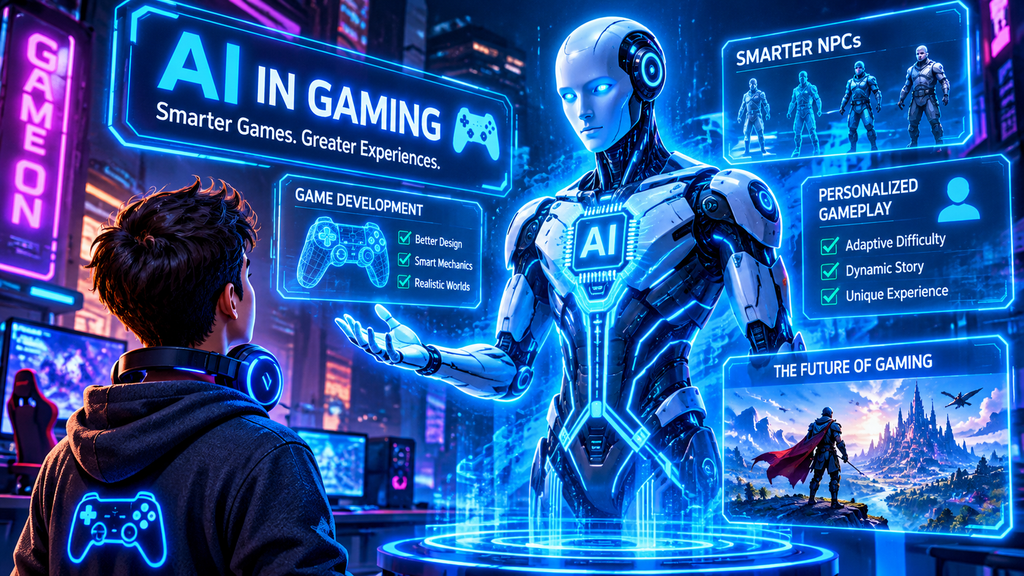
AI NPCs could work differently. A character might understand free-form speech, react to what you just did and hold a more natural conversation. Imagine negotiating with a merchant, reporting a crime or discussing a quest in your own words instead of choosing from four dialogue options.
NVIDIA describes its ACE technology as a suite of AI models and tools that helps developers build “knowledgeable, actionable, and conversational” in-game characters. At GDC 2026, NVIDIA added expanded language recognition, production-quality on-device text-to-speech and a small language model with agent abilities for AI characters.
The biggest public test so far is PUBG Ally. Krafton ran a public beta of this AI teammate in PUBG: Battlegrounds from June 17 to June 30, 2026, through Arcade Mode on Steam. It runs on the player’s own PC using speech recognition, the Mistral-NeMo-Minitron-2B small language model and text-to-speech. It can follow voice commands, loot, fight and talk back.
Ubisoft has a similar research project called Teammates. It features an AI voice assistant named Jaspar and two AI squadmates, Sofia and Pablo, who respond to the player’s voice in real time. Jaspar can highlight enemies, explain story details, change settings or pause the game on command.
Better conversation does not automatically mean better storytelling. A game still needs strong writing, clear quest design and consistent world rules. Real-time AI also adds latency (delay) and design trade-offs, so human designers still decide what those characters should say and do.
Can AI Create Entire Video Games?
AI can help build parts of a game, but it cannot yet reliably create a complete, polished, large-scale game on its own.
Google’s Project Genie, announced on January 29, 2026, came closest to the idea. It combines the Genie 3 world model with the Nano Banana Pro image model and Gemini to generate explorable 3D worlds from text or images. It was released to Google AI Ultra subscribers in the US.
Investors reacted sharply. Gaming stocks fell the next day, with Roblox dropping more than 13% and CD Projekt RED around 8%, while Take-Two and Unity also declined.
But the tool is limited. Experiences last only 60 seconds and have no overarching game world or level design. Unity CEO Matthew Bromberg said such outputs are “unsuitable on their own for games that require consistent, repeatable player experiences.”
Unity itself is moving toward “AI-driven authoring”, with the goal of letting developers prompt simple casual games into existence using natural language. That target is casual games, not open-world RPGs or competitive multiplayer titles, which still need art direction, level design, balancing, optimisation, testing and long-term support.
Will AI Make Games More Realistic?
AI is already improving how games look on PC. At GDC 2026, NVIDIA showed its RTX Kit, a set of neural rendering tools for ray-traced lighting, huge amounts of detailed geometry and photorealistic characters. It also previewed an RTX Mega Geometry foliage system for dense forests, which CD Projekt RED is bringing to The Witcher 4.
NVIDIA also introduced DLSS 4.5, which adds Dynamic Multi Frame Generation and a new 6x Multi Frame Generation mode. DLSS uses AI to boost frame rates and image quality on GeForce RTX graphics cards.
Realism is more than graphics, though. Players quickly notice repetitive dialogue, robotic voices and weak mission design. AI may reduce some of those problems, but it will not automatically make a game good.
What Players Can Expect
Expect to see more AI disclosure labels on Steam, which requires developers to disclose certain AI use. An independent analysis of Steam’s public data by Reddit user u/ploz found that 49.9% of new releases disclosed AI-generated content in October 2026, up from 26.4% in October 2025.
Most of that AI use is visual. Among disclosures, 63% involved AI artwork, 30% text and translations, 26% store pages and marketing, 21% music, 16% code, 7% AI voices and just 3% AI generating content during gameplay.
Smaller games lead the trend: 47% of 2026 releases with fewer than 10 Steam reviews disclosed AI use, compared with 14% of games with at least 1,000 reviews. This is not an official Valve report, and because disclosures are self-reported, the real figure may be higher.
Over the next few years, players are likely to see:
- More responsive NPCs and voice-controlled teammates
- AI-assisted graphics features such as DLSS on PC
- Faster testing and patches as studios use AI in QA
- AI-supported translation and accessibility tools
- More AI-assisted voice lines, depending on each studio’s policy
These changes will not arrive at the same pace everywhere. A big single-player RPG, a competitive shooter and a small indie game will all use AI differently.
Industry Context: AI vs Human Game Development

The industry is clearly divided. Jack Buser, global director for games at Google Cloud, has called generative AI the “Iron Man suit” of game development. On the other side, one developer in GDC’s January survey said they would rather “quit the industry than use generative AI.”
For AAA studios, AI may help control rising budgets and complex production pipelines. For indie developers, it could cut the time needed to build prototypes. The risk is a flood of low-effort AI games that makes it harder for players to find good ones.
What Happens Next?
The next major industry event is the GDC Festival of Gaming, set for March 1–5, 2027, at Moscone Center in San Francisco. AI is likely to be a major talking point again.
Krafton has not announced a full launch date for PUBG Ally beyond its beta. Ubisoft’s Teammates is still a research project, and Google’s Project Genie is still an experimental prototype.
Players should watch for clear disclosure from studios: which parts of a game used AI, whether human performers were involved and how AI shaped the final product. Until studios confirm otherwise, claims about fully AI-built AAA games should be treated as speculation.
Should You Be Excited?
There are real reasons for optimism. AI could cut development bottlenecks, make NPCs more engaging, improve accessibility and help small teams make games that would otherwise be too expensive.
That excitement should be balanced with caution. Consent, fair pay, disclosure and job security are still unresolved. The best games will still need strong ideas, skilled artists, thoughtful writers and developers who understand what makes gameplay fun.
Final Verdict: What We Know
AI in gaming is growing quickly, but it is not taking over game development the way some headlines suggest. GDC’s November 2026 report confirms that 40% of industry workers now use generative AI, mostly for research, brainstorming, coding and testing, and only 7% of those users apply it to player-facing features.
At the same time, 55% of professionals believe AI is hurting the industry, the highest level yet. Players are pushing back too, as ARC Raiders showed when Embark re-recorded some lines with human actors, while EA has leaned on consent from commentators such as Guy Mowbray.
AI NPCs, AI voices, AI rendering and AI world generators are real, but most are still early. Watch Steam’s disclosure trends, whether PUBG Ally gets a full launch and what studios say about AI at GDC 2027.
Table of Contents



Leave a Reply