

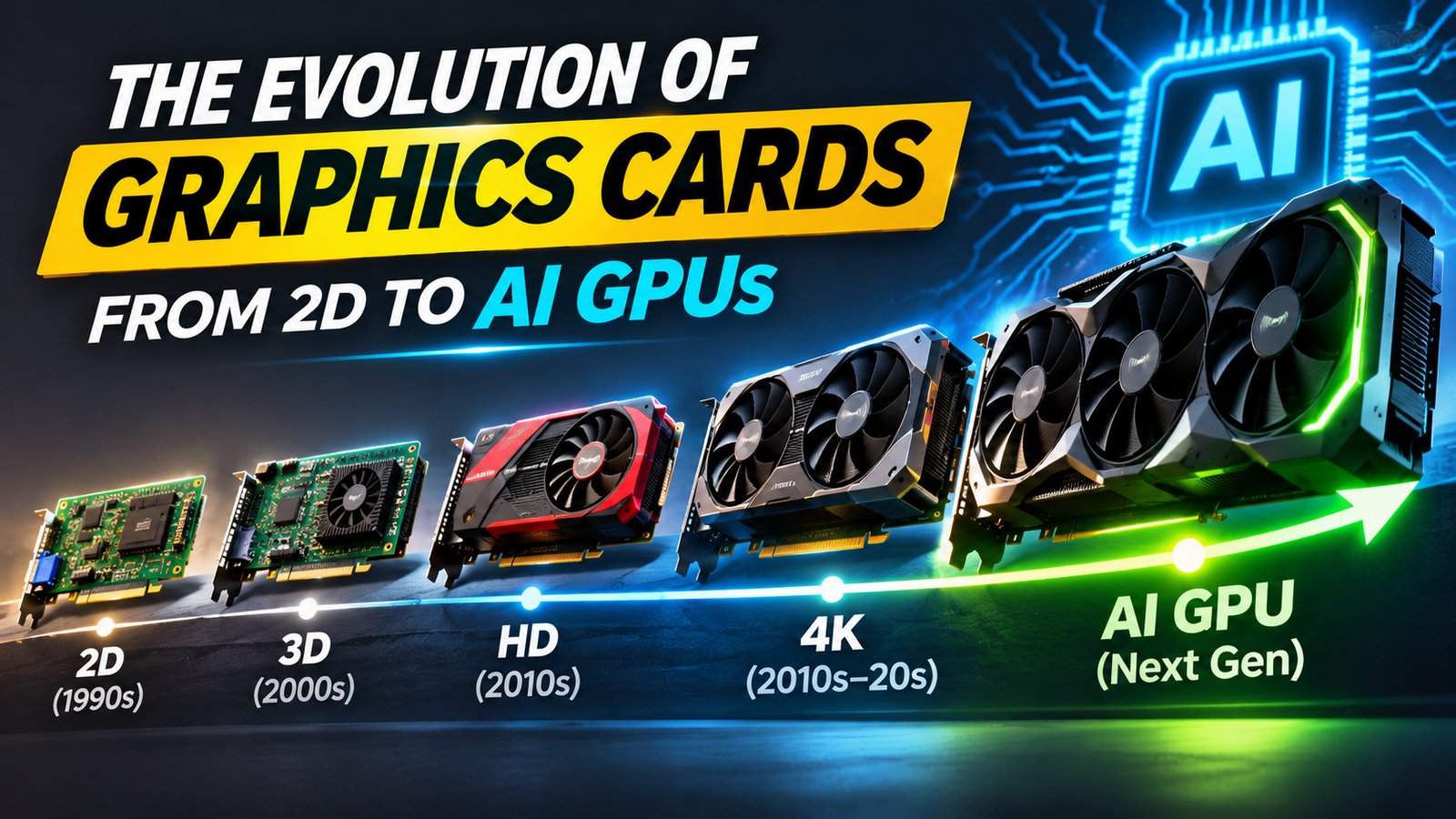
Nvidia has released a free Steam demo celebrating 20 years of the GeForce 8800 GTX, the card that put unified shaders and CUDA into gaming PCs. The demo, GeForce 8800 GTX 20 Years of a Legend, was announced on November 5, 2026. The card itself reached stores on November 8, 2006.
The anniversary is a good moment to look back at the full history of graphics cards. The story covers text-only adapters in 1981, the 3dfx Voodoo boom, the first GPU to carry that name, and today’s ray tracing and AI upscaling hardware. It also explains why some famous cards and companies vanished, and why each replacement arrived when it did.
What Happened?
The new demo was made by Unreal Engine artist Dylan Browne with Nvidia’s support. It lets players explore a 2006 era gaming room, unbox an 8800 GTX and install it in a PC tower.
It runs on GeForce RTX systems and needs Game Ready Driver 621.14 or newer. It uses DLSS 4.5 Ray Reconstruction, Dynamic Multi Frame Generation, path tracing and RTX Mega Geometry. Nvidia says it is also coming to GeForce NOW for Ultimate members.
In other words, Nvidia is using its newest rendering technology to celebrate one of its oldest landmark cards.
Where It Started:
The first PC graphics cards could not draw 3D at all. In 1981, IBM shipped its PC with the Monochrome Display Adapter (MDA) and the Color Graphics Adapter (CGA). Both were 2D only and were built around Motorola’s MC6845 video address generator, which launched in 1978.
The rest of the decade was about more colours and higher resolutions. Chips and Technologies brought EGA compatible chips in 1985. In August 1985, three Hong Kong immigrants, Kwok Yuen (K.Y.) Ho, Lee Lau and Benny Lau, founded Array Technology Inc. in Ontario, Canada. It later became ATI Technologies, and its Wonder card line led the market for years.
In the late 1980s and early 1990s, “2D accelerator” cards from companies such as S3, Cirrus Logic, Matrox and ATI took over jobs like drawing windows and moving images. This made Windows feel much faster. However, 3D games still ran in software on the CPU, which is why early 3D titles looked blocky and ran slowly.
S3 was founded in January 1989 by Dado Banatao and Ronald Yara, and its first Windows accelerator, the S3 911, arrived in 1991. Matrox, founded in Canada in 1976 by Lorne Trottier and Branko Matić, launched the MGA Millennium in 1995 with one of the first 64-bit graphics processors.
Cards also needed a faster way to talk to the rest of the PC. IBM’s ISA slot (1981) gave way to PCI in 1993. AGP followed in 1997 as the first slot made only for graphics. PCI Express arrived in 2004 and is still the standard today.
Nvidia joined the market late. Jensen Huang, Chris Malachowsky and Curtis Priem founded it on April 5, 1993, after meeting at a Denny’s in San Jose. Its first chip, the NV1, sold poorly. A planned console chip deal with Sega also fell through, which nearly sank the young company.
The 3D Boom: How 3dfx Voodoo Changed PC Gaming
The real turning point came from 3dfx Interactive. Three former Silicon Graphics engineers, Ross Smith, Gary Tarolli and Scott Sellers, founded it in San Jose on August 24, 1994, with backing from Gordon Campbell’s TechFarm. It sent its Voodoo Graphics chip to manufacturing on November 6, 1995, and Voodoo cards hit PCs in 1996.
Voodoo was a 3D-only add-on. You kept your normal 2D card and linked the two with a cable. The original chip ran at 50 MHz with 4 MB of memory. It was so far ahead of rivals that 3dfx reached an estimated 80–85% of the 3D accelerator market at its peak. Almost overnight, 2D-only cards looked obsolete for gaming.
The first board to use the chip was Orchid Technology’s Righteous 3D, released on October 7, 1996. Voodoo also came with 3dfx’s own programming interface, Glide. 3dfx built Glide because it judged Microsoft’s DirectX 3.0 too weak and saw OpenGL as a tool for CAD workstations. For a few years, a game with Glide support usually looked and ran best on a Voodoo card.
Nvidia answered in 1997 with the RIVA 128. It was one of the first consumer chips to handle both 2D and 3D on a single chip. It supported Microsoft’s Direct3D, topped several benchmarks and won close to 25% of the market by the end of that year.
That 2D-plus-3D design is the main reason add-on cards like the original Voodoo disappeared. Buyers did not want two cards when one could do both.
Why 3dfx Disappeared
The fall of 3dfx is one of the biggest collapses in PC gaming history. It came from several business mistakes, not one bad card.
The budget card flopped. The Voodoo Rush, a cheaper all in one board, failed to impress in 1997.
It stopped selling chips to partners. In December 1998, 3dfx paid $141 million for board maker STB Systems so it could build its own cards. Board makers that had sold Voodoo cards switched to Nvidia and ATI instead. STB had actually been Nvidia’s largest customer.
Its products fell behind. The Voodoo 5 slipped to 2000, while Nvidia’s GeForce 2 GTS and ATI’s Radeon DDR were already out. The Voodoo 4 4500 could not compete. The famous four chip Voodoo 5 6000 never reached retail.
Glide stopped being an advantage. Glide only worked on 3dfx hardware. As Direct3D and OpenGL improved, developers preferred APIs that ran on every card. 3dfx itself said developers wanted to focus on Direct3D and OpenGL when it released Glide as open source in December 1999.
The money ran out. In a later SEC filing, 3dfx pointed to high research costs, heavy debt, lost customers after the STB deal and an inability to refinance.
On December 15, 2000, Nvidia agreed to buy 3dfx’s core assets. The deal was $70 million in cash plus one million Nvidia shares, a total value of about $112 million. Nvidia took the patents, the chip inventory and the 3dfx and Voodoo names. It did not take on 3dfx’s debts or its board factory.
The First “GPU”: GeForce 256
Nvidia announced the GeForce 256 on August 31, 1999, and released it on October 11, 1999. A faster DDR version followed on December 13.
Nvidia called it “the world’s first GPU”. The key change was hardware transform and lighting (T&L). Before this, the main processor (CPU) had to work out where every triangle sat in 3D space and how light hit it. The GeForce 256 moved that work onto the graphics chip.
Nvidia’s own definition of a GPU was a single chip with built-in transform, lighting, triangle setup/clipping and rendering engines, able to process at least 10 million polygons per second.
The chip had about 23 million transistors and was the first card with full DirectX 7 support. It also led to Nvidia’s Quadro cards for professional design work. Co founder Chris Malachowsky has said Nvidia faced 35 competitors when the card launched.
ATI vs Nvidia, and the End of the ATI Name
The 2000s became a two company race between Nvidia’s GeForce and ATI’s Radeon. Each generation added features that are now standard, such as bump mapping and shadow volumes.
In 2006, AMD announced a $5.4 billion deal to buy ATI. At the time, ATI was run by CEO Dave Orton, and AMD by CEO Hector Ruiz. Radeon cards kept the ATI badge for four more years.
On August 30, 2010, AMD said it would retire the ATI brand. The Radeon HD 6000 series was the first to launch as “AMD Radeon”. AMD said its research showed buyers rated the AMD name more highly than ATI once they knew about the merger, and that Radeon was strong enough on its own.
GeForce 3: When Graphics Cards Became Programmable
The GeForce 256 still used “fixed-function” hardware. It could only run the effects built into the chip.
That changed with the GeForce 3, released on February 27, 2001. It was the first card built for DirectX 8.0, with programmable vertex and pixel shaders. Shaders are small programs written by game developers that decide where objects sit and what colour each pixel is.
This gave artists far more control. It made effects like realistic water in The Elder Scrolls III: Morrowind and per-pixel lighting in Doom 3 possible. A version of the same chip, the NV2A, powered Microsoft’s first Xbox console.
The 8800 GTX: Why Unified Shaders Took Over
Older GPUs, including Nvidia’s GeForce 7 series, used separate units for vertex work (the shape of objects) and pixel work (their colour and lighting). If a scene was heavy on one type, the other units sat idle.
A unified shader design lets any unit do either job. ATI was first to ship this idea in a mass-market chip, the Xenos GPU inside the Xbox 360 in 2005.
Nvidia brought it to PCs with the GeForce 8800 GTX on November 8, 2006, priced at $599. Its G80 chip had 128 unified stream processors, 768 MB of GDDR3 memory and a 384 bit memory bus. It was the first DirectX 10 card and the first CUDA capable card.
CUDA followed in 2007. It let programmers use the GPU for general calculations, not just graphics. That decision later made Nvidia GPUs the main hardware for AI training.
The turning point came in 2012. A University of Toronto team trained the AlexNet image recognition network on two gaming cards, Nvidia GeForce GTX 580s with 3 GB of memory each. Training took five to six days. AlexNet won that year’s ImageNet competition with a 15.3% error rate, far ahead of the runner up, and kicked off the modern AI boom on GPUs.
The GTX Years: Hot Chips, Hard Lessons (2008–2019)
Between the 8800 GTX and the first RTX cards, Nvidia’s gaming line went through some of its biggest wins and worst mistakes.
A simpler name. Nvidia had used “GTX” as a label on top cards for years, such as the 7800 GTX (2005) and 8800 GTX (2006). On June 16, 2008, it moved GTX to the front of the name with the GeForce GTX 280 ($649) and GTX 260 ($399). Old model numbers had become confusing, so the new scheme made it easier to see which card was faster. Nvidia also marketed these cards for more than games, using CUDA and PhysX physics effects.
Too hot, then fixed. The GTX 480 arrived in March 2010 on the new Fermi design. It was the fastest single GPU card, but reviewers criticised its heat, noise and power use. Eight months later, on November 9, 2010, the $500 GTX 580 fixed most of this. It was roughly 15% faster while using about 10% less power, with a quieter cooler.
A smarter speed boost. The GTX 680 launched on March 22, 2012, for $499. It was the first Kepler card and introduced GPU Boost. This feature automatically raises the card’s clock speed when temperature and power allow, much like turbo mode on a CPU.
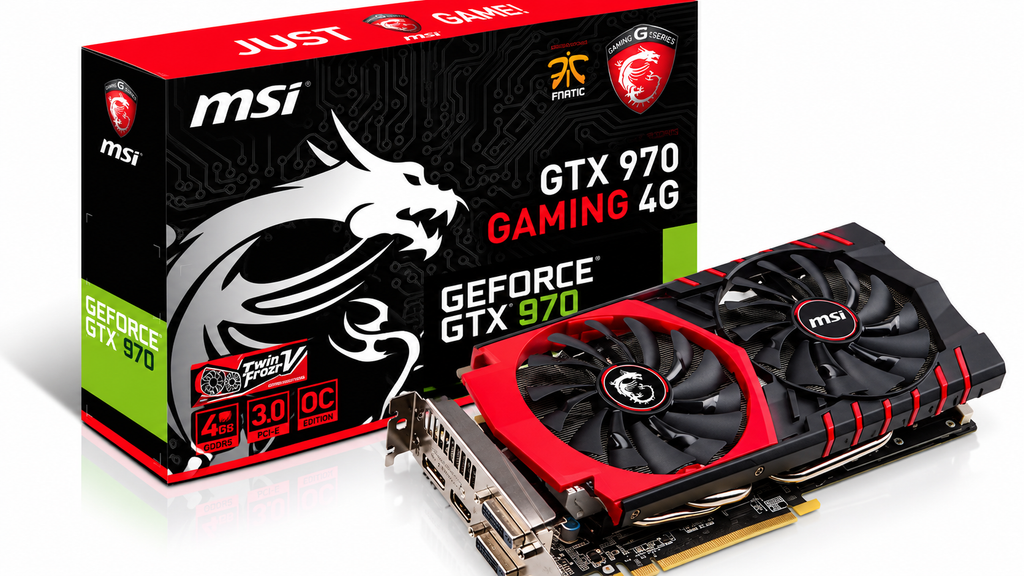
The GTX 970 memory problem. The GTX 970 launched in September 2014 for around $350, sold as a 4 GB card. Buyers later found that only 3.5 GB ran at full speed, while the last 0.5 GB was much slower. That caused stutters in games that used more than 3.5 GB. Nvidia blamed poor communication between its engineers and marketing team. In 2016, it agreed to a US settlement paying $30 per card, without admitting wrongdoing.
The people’s card. The GTX 1060 launched in August 2016 at $249. It became the most-used graphics card in Steam’s monthly hardware survey for several years. In June 2019, about 15.5% of surveyed Steam users had one. The cheaper GTX 1650 finally overtook it in November 2022.
Crypto miners empty the shelves. Cryptocurrency mining made gaming cards hard to buy twice: around 2017–2018, and again from late 2020 to early 2022. Miners bought cards in bulk because Ethereum could be mined on ordinary GPUs. That ended on September 15, 2022, when Ethereum switched to a system that no longer needed GPU mining, and card prices dropped soon after.
The end of GTX. The GTX 16 series launched on February 22, 2019. These cards used the same Turing design as the RTX 20 series, but without RT cores or Tensor cores, to keep prices low. The last new model, the GTX 1630, came out on June 28, 2022, and got poor reviews. Nvidia stopped producing GTX 16 chips in early 2024, which made its whole gaming line RTX.
The RTX Era: Ray Tracing, AI Upscaling and a Third Player
Nvidia unveiled the GeForce RTX 20 series at Gamescom on August 20, 2018, and shipped the first cards on September 20. These Turing cards added RT cores for real time ray tracing and Tensor cores for AI work, which power DLSS upscaling.
The launch was not smooth. The RTX 2080 Ti cost $999 and the RTX 2080 cost $699, and no games supported ray tracing or DLSS on day one.
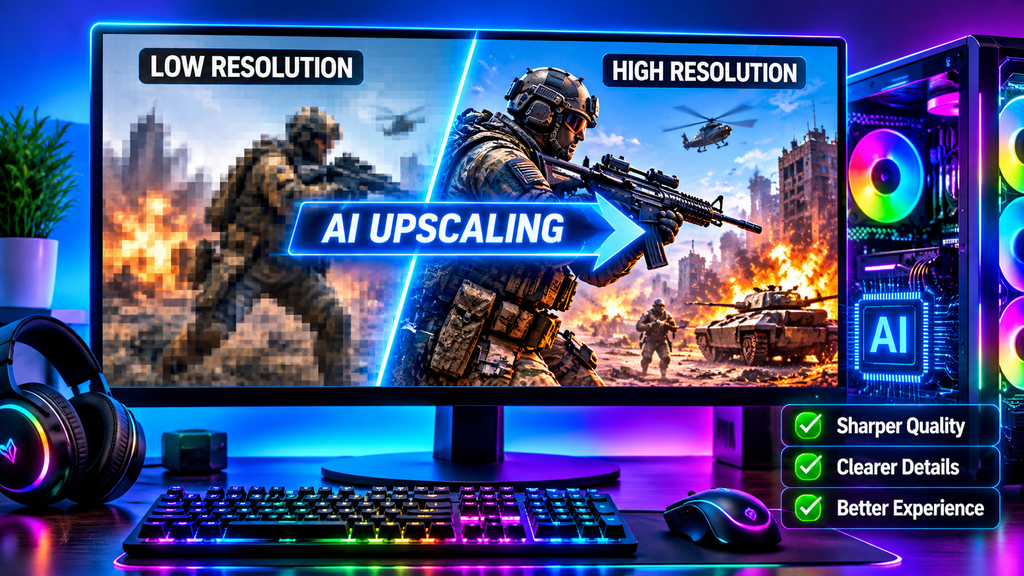
AMD answered DLSS with FidelityFX Super Resolution (FSR), released on June 22, 2021, in seven games. Unlike DLSS, FSR did not need AI hardware, so it also ran on older Radeon cards and even Nvidia GTX 10 series GPUs.
The RTX 30 series made these features far more useful. Nvidia announced it on September 1, 2020. The RTX 3080 went on sale on September 17 for $699, and the RTX 3090 followed on September 24 for $1,499. It arrived alongside DLSS 2.0, a rebuilt version that fixed the blurry image quality of the first DLSS. Big games such as Fortnite and Cyberpunk 2077 then added ray tracing and DLSS support.
Intel then returned to gaming graphics. Arc laptop chips launched first, on March 30, 2022. The desktop Arc A770 and A750 followed on October 12, 2022, with the A770 starting at $329. It was Intel’s first serious gaming card since the i740 in 1998.
At CES on January 6, 2025, Nvidia revealed the RTX 50 series, built on its Blackwell architecture. The RTX 5090 launched at $1,999 with a 575 W power rating. Its DLSS 4 Multi Frame Generation can use AI to create up to three extra frames for every frame the GPU renders.
Who’s Behind the Graphics Card Companies?
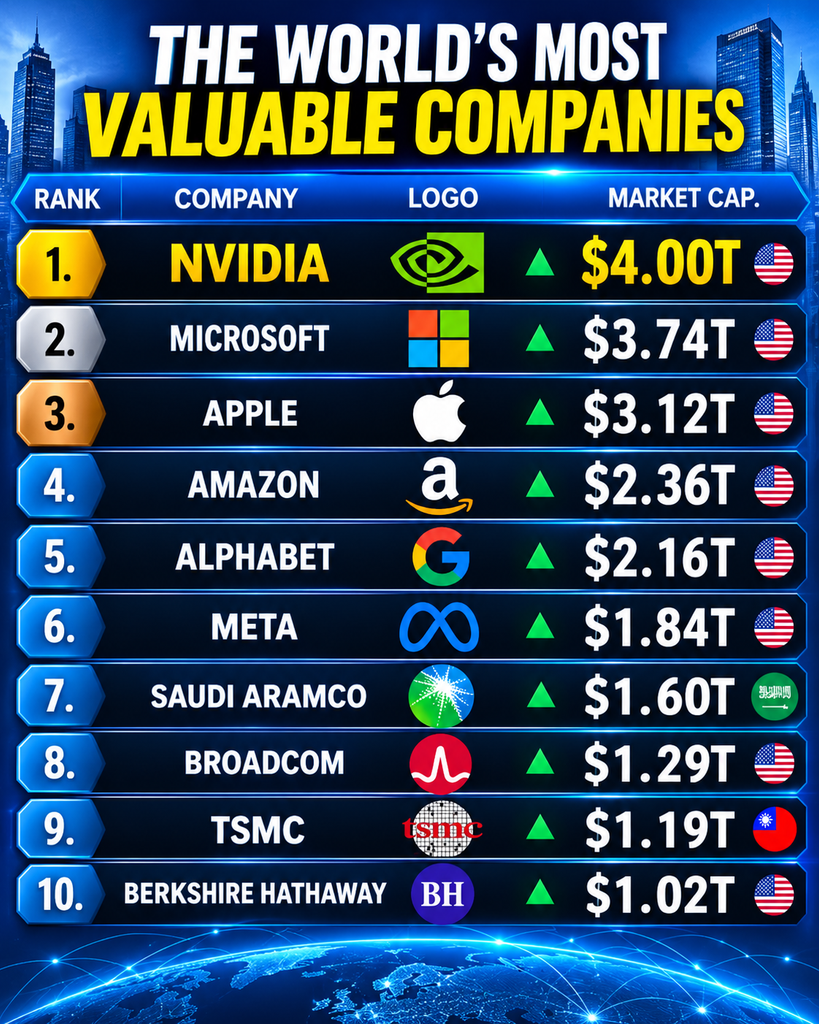
Only three companies design gaming GPUs today: Nvidia, AMD and Intel. All three are publicly traded, so shareholders own them and a CEO runs them. Other brands, like ASUS and MSI, buy those chips and build the actual cards you see in stores.
The chip designers, past and present
| Company | Founded | Founders | Who runs it now / what happened | Graphics brand |
| Nvidia | April 5, 1993, California | Jensen Huang, Chris Malachowsky, Curtis Priem | CEO Jensen Huang. He resigned on Nov 12, 2026 and the board reinstated him on Nov 23, 2026 | GeForce |
| AMD | 1969, California | Jerry Sanders and co-founders | Chair and CEO Lisa Su | Radeon (formerly ATI) |
| Intel | 1968, California | Robert Noyce, Gordon Moore | CEO Lip-Bu Tan | Arc |
| ATI Technologies | August 1985, Ontario, Canada | K.Y. Ho, Lee Lau, Benny Lau | Bought by AMD in 2006; name retired in 2010 | Radeon, Rage, Mach |
| 3dfx Interactive | August 24, 1994, San Jose | Ross Smith, Gary Tarolli, Scott Sellers | Assets sold to Nvidia in December 2000 | Voodoo |
| Matrox | 1976, Quebec, Canada | Lorne Trottier, Branko Matić | Fully owned by Lorne Trottier since 2019; no longer designs its own gaming GPUs | Millennium, Mystique |
| S3 Graphics | January 1989, California | Dado Banatao, Ronald Yara | Later controlled by VIA; HTC bought VIA’s stake in 2011 | Trio, ViRGE |
The card makers (board partners)
| Brand | Based in | Owner / key people | Cards it sells |
| ASUS | Taipei, Taiwan (1989) | Founded by T.H. Tung, Ted Hsu, Wayne Hsieh and M.T. Liao; chairman Jonney Shih | Nvidia and AMD |
| MSI | New Taipei, Taiwan (1986) | Publicly listed Taiwanese company | Nvidia and AMD |
| Gigabyte | Taiwan | Publicly listed Taiwanese company | Nvidia and AMD |
| Palit (also Gainward, GALAX/KFA2) | Taipei, Taiwan (1988) | Founded by Li Shilong; bought Gainward in 2005 | Nvidia |
| Zotac and Inno3D | Hong Kong | PC Partner Group (founded 1997), which also builds Sapphire cards | Nvidia |
| Sapphire | Hong Kong | Privately held | AMD only |
| PowerColor | New Taipei, Taiwan (1997) | TUL Corporation | AMD |
| XFX | Hong Kong | Pine Technology Holdings | AMD |
Nvidia, AMD and Intel also sell some cards under their own names, such as Nvidia’s Founders Edition models.
Quick Questions About GPU History
Was the GeForce 256 really the first GPU? Only by Nvidia’s own definition. Analyst Jon Peddie notes the term “GPU” was used as early as the 1980s. Nvidia made it popular in 1999.
Why did graphics cards get so big and power-hungry? Performance rose faster than efficiency. The RTX 2080 Ti Founders Edition averaged around 300 W in games. The RTX 3090 could peak at about 450 W, the RTX 4090 is longer than 300 mm, and the RTX 5090 is rated at 575 W.
Did the market always look like it does now? No. Graphics card shipments peaked at about 114 million units in 1999, when dozens of companies were competing. By Q3 2013, Jon Peddie Research counted Nvidia at 64.5% of the add-in board market and AMD at 35.5%.
Why did the original Voodoo need a second graphics card? It was a 3D only accelerator. Your normal 2D card handled Windows, and a pass-through cable switched the monitor to the Voodoo when a 3D game started. Single chip 2D/3D cards like Nvidia’s RIVA 128 (1997) made this setup unnecessary.
What was the first programmable GPU? The GeForce 3, released in February 2001, is widely seen as the first, because it supported DirectX 8.0 vertex and pixel shaders.
How did a gaming card end up powering AI? GPUs run thousands of simple maths operations at once, which is exactly what neural networks need. CUDA (2007) made that power easy to program. In 2012, AlexNet was trained on two GeForce GTX 580 gaming cards and won the ImageNet contest.
How much did Nvidia pay for 3dfx: $112 million or $120 million? The deal announced on December 15, 2000, was $70 million in cash plus one million Nvidia shares. Based on Nvidia’s share price on December 14, 2000, that came to about $112 million. Some reports round it differently, so $112 million is the figure tied to the deal’s own terms.
Did Intel make graphics cards before Arc? Yes. The Intel i740 launched in 1998. Intel’s Larrabee project around 2009 also aimed at graphics but never became a gaming product. Arc (2022) was Intel’s first serious return.
Who leads the graphics card market today? Nvidia, by a wide margin. Jon Peddie Research puts Nvidia at about 94% of add-in graphics card shipments in Q4 2025, with AMD at 5% and Intel at 1%. In Q2 2026, Nvidia held around 90% of desktop discrete GPUs, AMD about 8% and Intel about 2%.
Is DLSS better than FSR? They work differently. DLSS uses AI on the Tensor cores of Nvidia RTX cards. The original FSR (2021) used a non-AI method, so it ran on almost any recent GPU, including Nvidia’s GTX 10 series. Image quality comparisons depend on the game and the version used.
What Happens Next?
The next chapter is being shaped by memory chips, not new GPU designs. Several reports say memory makers are shifting production toward AI data centres. That is pushing up the cost of the GDDR memory used on graphics cards.
Multiple outlets have reported that AMD told partners it would raise graphics card prices by at least 10% in 2026. AMD has not publicly confirmed this. A November 2026 supply-chain report also claims AMD cut gaming GPU allocations to partners in China, possibly into January 2027. That claim also remains unconfirmed by AMD.
On the roadmap side, reports say Nvidia’s future Feynman architecture will use TSMC’s 1.6 nm A16 process. Nvidia has not announced a release date for a successor to the RTX 50 series. Gamers should treat any launch timing as speculation until Nvidia, AMD or Intel confirm it.
Final Verdict: What We Know
The history of graphics cards follows a clear pattern. Every big jump moved more work away from the CPU and onto a dedicated chip. First came 3D drawing, then transform and lighting, then fully programmable shaders, and now ray tracing and AI-generated frames.
Companies that missed these shifts, like 3dfx, did not survive. Companies that bet early, like Nvidia with CUDA, ended up leading the industry.
Nvidia’s 8800 GTX demo is a reminder of how fast things have moved in just 20 years. The questions to watch now are whether memory shortages keep prices high, and when the next generation of GeForce, Radeon and Arc cards is officially announced.
Got a question about GPU history? Maybe you want to know about a card we didn’t cover, or you still have your old Voodoo or GeForce. Drop it in the comments below, and we’ll answer as many as we can.
Table of Contents





Leave a Reply