China’s AI Chip Ban 🇺🇸 Trump Reaction What It Means for Tech, Markets & Gaming
🏛️ What Happened
China recently issued a directive requiring state-funded data centres to stop using foreign-made AI chips, including or especially those from companies like Nvidia and AMD. KAOHOON INTERNATIONAL+1
In response, President Trump publicly stated that the most advanced NVIDIA Blackwell chips will be reserved for U.S. companies only. “We don’t give the Blackwell chip to other people,” he said. Reuters
This signals a major escalation in the tech-and-trade tussle between the U.S. and China.
📈 Market Reaction & Stock Movements
- After Trump’s comments, Nvidia stock surged as investors interpreted them as support for U.S.-based dominance in AI chips. Nasdaq+1
- At the same time, Chinese chip companies and domestic manufacturers saw a potential boost as China pivots to in-house chip production to replace foreign imports. The Business Standard
- Broader tech markets show increased volatility, especially in semiconductor stocks and companies tied to China supply chains companies, hardware makers, game-gear manufacturers all may feel the impact.
🎮 Impact on Gaming & Hardware
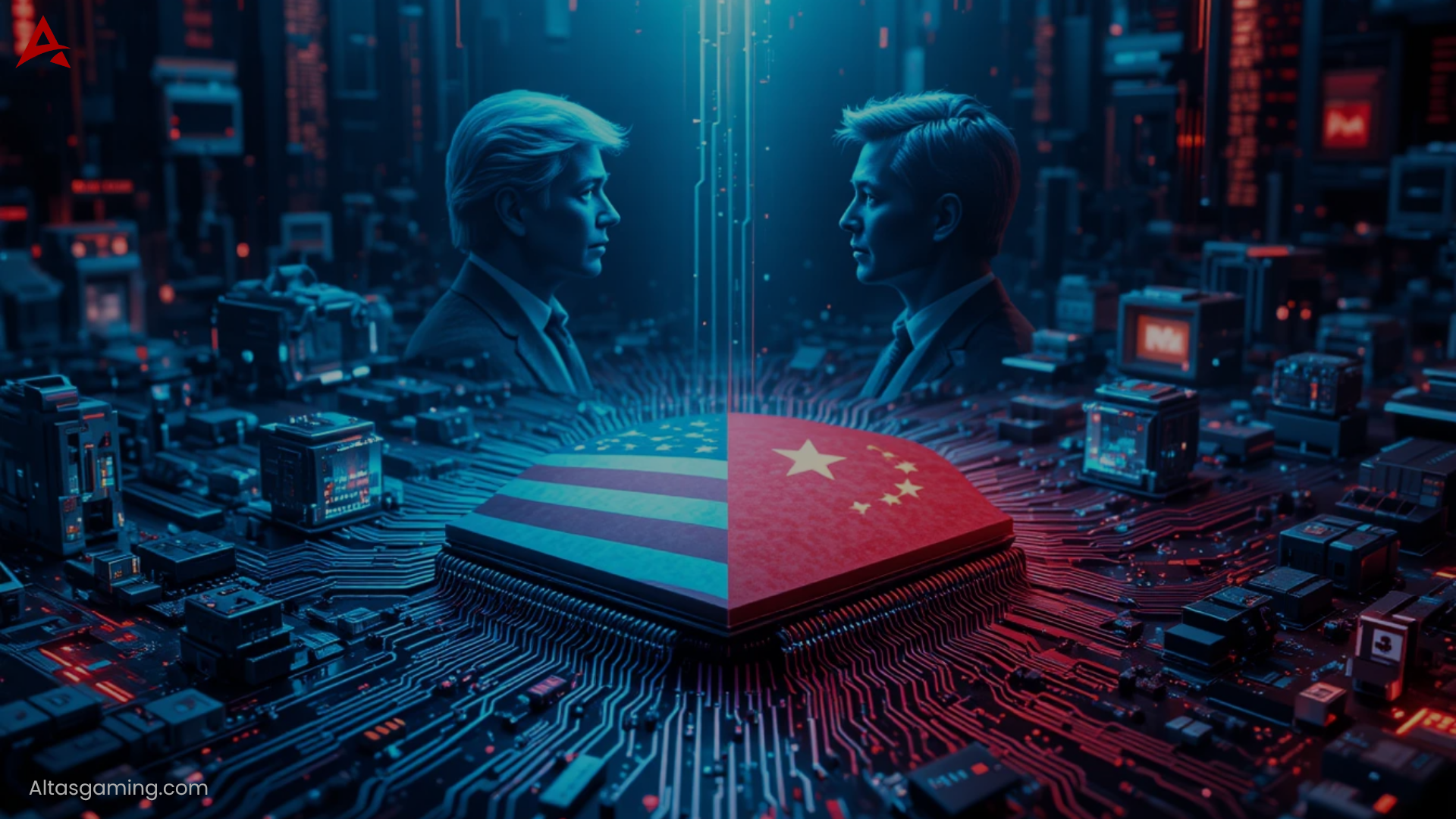
- Many gaming consoles, GPUs, PC motherboards and high-end accessories depend on the same chip ecosystems that Trump and China are now battling over. The restrictions and responses could lead to higher prices, reduced supply or shifts in manufacturing locations.
- Game studios in the USA, UK, Canada, Australia and Germany that rely on components imported from China (or built on Chinese supply chains) may see cost increases, delays or the need to redesign hardware for alternate markets.
- For gamers, especially those building high-end rigs or importing hardware globally, this means tracking tariffs, chip-availability and geopolitical risk has become part of the decision-tree.
💬 What People Are Saying
- U.S. tech policy experts say Trump’s stance will solidify U.S. chip dominance but may also accelerate China’s drive to build self-sufficient chip-ecosystems possibly eroding American lead in the long run. Brookings
- In China, media and analysts view the directive as a strategic move to reduce reliance on foreign tech and boost domestic champions like Huawei Technologies, Cambricon and Moore Threads. KAOHOON INTERNATIONAL+1
- Within the global gaming industry, some hardware suppliers are reportedly revisiting supply chains and manufacturing locations to avoid tariff-risk and component scarcity.
🧭 Unique Insight – Why Gamers & Developers Should Care
While much of the commentary focuses on macro-economics, the under-the-radar story is the gaming ecosystem:
- Many next-gen gaming experiences require AI-driven infrastructure real-time world simulation, cloud-gaming back-ends, advanced graphics chips. The chip war affects these foundations.
- If China builds a parallel supply-chain, hardware specifications may diverge between “Western” and “Chinese” markets game studios might need to build dual-hardware versions of titles to remain compatible globally.
- For players and developers in the key regions (USA, UK, Canada, Australia, Germany), what used to be a hardware buying decision now also includes geopolitical risk and “where was it manufactured?” considerations.
✅ Final Thoughts
Trump’s reaction to China’s AI chip ban marks another turning point in the tech-trade war, with real implications for stocks, tech companies, the gaming industry, and global supply chains.
For gamers, hardware builders, studios and developers in the USA, UK, Canada, Australia and Germany, the message is clear: geopolitics matters. The next high-end GPU you buy, the console release you anticipate, the cloud-game you stream all may be shaped by decisions made in boardrooms and capitals far removed from the living room.
It’s no longer just about specs and refresh rates it’s about where your chips come from, who controls them, and how trade politics affect your game.
🔍 FAQs
Q1: Why did China ban foreign AI chips from its data centers?
A: China’s government reportedly banned foreign AI chips to promote self-reliance in semiconductor technology and protect national security. This move aims to strengthen local manufacturers and reduce dependence on U.S.-made chips like Nvidia and AMD.
Q2: How did Donald Trump react to China’s AI chip ban?
A: Trump responded strongly, saying that the U.S. will prioritize Nvidia’s Blackwell chips for domestic companies. He emphasized that such advanced technology shouldn’t be shared with foreign nations, hinting at a more protectionist tech policy.
Q3: What are the effects of this ban on global stock markets?
A: Nvidia and other U.S. chip stocks initially surged due to increased demand for U.S.-based AI chips. However, global markets remain volatile, as the ban could lead to supply chain disruptions, price hikes, and uncertainty in the tech sector.
Q4: How will this impact the gaming industry?
A: The gaming industry could face hardware shortages and rising GPU prices. Since high-performance gaming PCs rely on AI and graphics chips, delays or export restrictions could affect new console launches and next-gen game development globally.
Q5: What does this mean for cryptocurrency and forex markets?
A: The AI chip war has already influenced crypto and forex volatility. Investors are viewing AI-related assets and semiconductor-linked tokens like XAUSDT (Gold/USDT) as safe havens amid uncertainty in tech markets.
Q6: Could China’s chip ban benefit domestic companies?
A: Yes. Companies like Huawei, Cambricon, and Moore Threads might benefit as China pushes for domestic chip innovation. This could reduce U.S. market dominance but take years before local alternatives match Nvidia’s performance.
Q7: What does this mean for gamers in countries like the USA, UK, Canada, and Australia?
A: Gamers in these regions might face price increases on high-end GPUs or limited availability of imported gaming hardware. It could also spark competition between Western and Eastern gaming ecosystems, potentially leading to region-specific releases.
Q8: Are there any long-term benefits of the U.S.–China AI chip standoff?
A: In the long term, it could accelerate innovation and diversification in AI chip design. However, it may also create a split tech world, where countries align with either U.S. or Chinese ecosystems for hardware, software, and cloud gaming infrastructure.
Table of Contents
- Resident Evil Requiem Becomes 2026’s Highest-Rated Game – A Survival Horror Masterpiece or an Overhyped Sequel That Loses Steam?
- Black Ops 7 Sets a New Standard for Tactical FPS Combat – But Controversy and Matchmaking Frustrations Spark Debate
- Ghostrunner 2 Free on Epic Games, A Cyberpunk Masterpiece of Relentless Action – or a Brutally Punishing Game That’s Too Hard to Love?
- Code Vein II Is a Beautiful Evolution – But Its Uneven World Holds It Back! Or Does It Still Lack the Crown? (Feb 2026)
- Nioh 3 Review- A Brutal Soulslike Masterpiece That Perfects Samurai Combat – Or an Unforgiving Grind That Pushes Players Too Far?


GIGABYTE B550M K Motherboard
GIGABYTE B550M K Motherboard
About this item
- AMD AM4 Socket: Supports AMD Ryzen 5000 Series or Ryzen 5000 G-Series or Ryzen 4000 G-Series and Ryzen 3000 Series Processors
- DDR4 Compatible: Dual Channel ECC or Non-ECC Unbuffered DDR4, 4 DIMMs
- Sturdy Power Design: 4 plus 2 Phases Digital Twin Power Design with Low RDS(on) MOSFETs
- Connectivity: PCIe 4.0 x16 Slot, Dual Ultra-Fast NVMe PCIe 4.0 or 3.0 x4 M.2 Connectors, Realtek GbE LAN chip
- Fine Tuning Features: RGB FUSION 2.0, Supports Addressable LED and RGB LED Strips, Smart Fan 5, Q-Flash Plus Update BIOS without installing, CPU, Memory, and GPU
| Brand | GIGABYTE |
| CPU Socket | Socket AM4 |
| Compatible Devices | Personal Computer |
| RAM Memory Technology | DDR4 |
| Compatible Processors | AM4 (Ryzen 5000/3000/4000) |
| Chipset Type | AMD B550 |
| Memory Clock Speed | 3200 MHz |
| Platform | Windows 11 |
| Model Name | B550M K |
| CPU Model | Others |
From the brand

-

-


Best Sellers
-



Product information
Additional Information
| Customer Reviews |
4.4 out of 5 stars |
|---|---|
| Best Sellers Rank |
|
Warranty & Support
Feedback


Leave a Reply