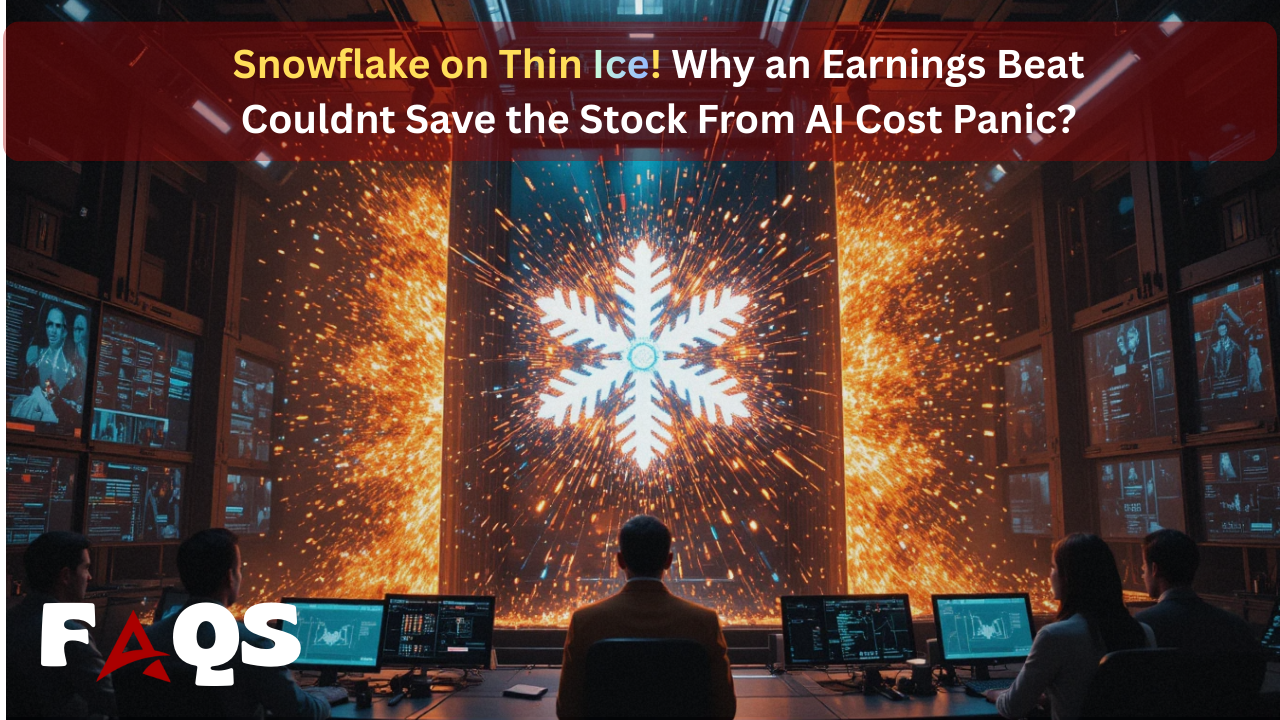
Snowflake on Thin Ice! Why an Earnings Beat Couldnt Save the Stock From AI Cost Panic?
When a company posts an earnings beat, it often sends the stock upward. But for Snowflake, the results announced in its third quarter of fiscal 2026 have been met with muted investor enthusiasm even concern. Here’s why a strong quarter may not be enough to reverse downward pressure on the stock.
The Q3 Report Good Results, But Mixed Signals
Snowflake’s Q3 results delivered on several fronts
- Revenue and cloud-data product adoption reportedly grew, showing continued enterprise demand.
- The company reiterated its position as a leading cloud-data + AI-ready platform encouraging for long-term growth.
- Its “Data Cloud” and related services continue drawing interest, especially from companies investing in data analytics and AI infrastructure.
These factors paint a picture of a company still relevant, with a base of recurring revenue and exposure to promising data + AI trends.
But the Margin Warning Changed Everything
Despite top-line strength, Snowflake’s guidance for profit margins especially in light of rising investments into AI infrastructure and anticipated costs was notably cautious. On the earnings call and in accompanying investor documents, the company warned that
- Operating margins might shrink due to higher expenses tied to AI readiness, increased data-processing costs, and infrastructure scaling.
- Growth investments, cloud compute costs, and R&D for AI features could delay near-term profitability improvements.
- As AI workloads increase, cost-per-query and data-warehouse costs may rise potentially eroding the efficiency that helped Snowflake stand out previously.
These warnings triggered unease among analysts and investors if Snowflake cannot control costs while pushing AI adoption, future profitability may be compromised.
Why the Stock Didn’t Rally And Might Even Stay Under Pressure
1. Sentiment Over Numbers
Investors are increasingly pricing not just on current results, but on future predictability and margin stability. A margin warning, especially in a high-cost environment, undermines confidence.
2. AI Costs Are Still an Unknown
With AI workloads, data demand is spiking but so are compute and storage costs. Without clear cost controls, many worry that Snowflake becomes a costly utility, not a high-margin growth engine.
3. Valuation Gaps
Snowflake’s valuation was already pricing in aggressive growth. With margins threatened, the stock loses “growth premium,” making traditional valuation metrics (e.g. price-to-sales) less appealing.
4. Competition and Alternatives
As cloud and AI infrastructure competition intensifies (with rivals offering lower-cost or in-house solutions), Snowflake must do more to justify its premium price and margin compression is the opposite of that.
5. Macro and Macro-Cost Headwinds
Rising global cloud infrastructure costs, inflation, and interest-rate concerns all weigh heavier on companies whose profitability depends on large-scale data processing.
What This Means for Snowflake Risks, Challenges & Watch Points
- Short-term volatility Expect swings in stock price as analysts reassess growth vs cost profile.
- Margin pressure for at least 2–3 quarters Until AI data workloads scale enough to amortize infrastructure costs.
- Demand for cost efficiency innovations Snowflake will need to introduce features that reduce compute/storage overhead.
- Risk of slower enterprise adoption Big customers may delay data-heavy AI projects if costs remain high.
- Heightened scrutiny from investors & markets More sensitivity to future guidance than past results.
The Earnings Beat Was Real But the Marathon Is Just Starting
Snowflake is not dead by any stretch. Its Q3 results prove demand is still there. But in today’s post-AI-boom market, a beat isn’t enough. What investors now look for is cost discipline, scalable profitability, and transparent AI-cost management.
If Snowflake can navigate this transition and show that growth and margin can coexist the long-term upside remains intact. But the near term may be rough: the company is no longer sailing under fair-weather winds.
And for many investors, those margin warnings are too heavy a risk to ignore
 ltas Opinion
From Alta’s Desk
Snowflake’s situation is a classic example of a tech company caught in the crossfire between AI hype and AI reality. Investors love the story scalable data cloud, AI-ready architecture, enterprise growth but the economics underneath are starting to crack.

The truth? Snowflake’s business model is extremely sensitive to compute costs, more than many investors realize. Every AI feature Snowflake adds pushes more data through expensive third-party cloud infrastructure. Until Snowflake either builds cheaper internal systems or finds smarter ways to optimize workloads, margins will keep shrinking.
The earnings beat didn’t move the stock because Wall Street now cares about one thing above all
Can Snowflake prove it can profit from AI, not drown in the costs of delivering it?
As long as Snowflake relies on hyperscaler infrastructure while competing against hyperscalers (AWS, GCP, Azure), it will walk a tightrope.
My prediction:
Snowflake’s next 12–18 months will be the company’s most defining test ever.
They either evolve or get overtaken by more cost-efficient AI-native platforms.
FAQs
1. Why is Snowflake more vulnerable to AI compute costs than most cloud companies?
Because Snowflake doesn’t own the infrastructure it rents it from AWS, Azure, and Google Cloud, making scaling extremely expensive during AI workload surges.
2. Could Snowflake eventually build its own data centers like Google or Oracle?
Yes, but only if Snowflake decides to shift its long-term strategy toward partial vertical integration. It would require billions in capex and years of planning.
3. Are AI features actually reducing Snowflake’s profitability?
In the short term, yes. New AI tools increase customer usage, but they also trigger heavier compute spikes that Snowflake must pay cloud partners for.
4. Could Snowflake’s stock fall even after multiple earnings beats?
Absolutely if future costs outpace revenue growth, markets reprice the stock as “high growth, low margin,” which destroys valuation premiums.
5. What is the biggest risk nobody is discussing about Snowflake?
That big enterprises may develop in-house AI data solutions to escape Snowflake’s scaling costs meaning Snowflake’s long-term moat might shrink.
Table of Contents
- Is World War 3 coming Iran–Israel–USA Conflict 2026 The Complete Story, Hidden Tensions, and What Could Happen Next
- Taiwan Invasion by 2027 – But the Real War for AI, Chips, and Global Power Has Already Begun
- Resident Evil Requiem Becomes 2026’s Highest-Rated Game – A Survival Horror Masterpiece or an Overhyped Sequel That Loses Steam?
- Black Ops 7 Sets a New Standard for Tactical FPS Combat – But Controversy and Matchmaking Frustrations Spark Debate
- Ghostrunner 2 Free on Epic Games, A Cyberpunk Masterpiece of Relentless Action – or a Brutally Punishing Game That’s Too Hard to Love?

Crosshair A17 HX D8W
Crosshair A17
Product Description
Efficient Performance
Equipped with the top-tier Ryzen 9 8940HX processor featuring up to 16 cores, this MSI Crosshair laptop delivers exceptionally fast performance for gaming, streaming, and demanding multitasking.
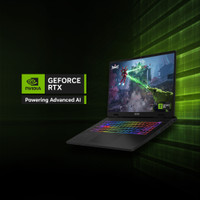
Excellent Graphics
Enjoy premium visuals with the NVIDIA GeForce RTX 5070, supporting DLSS 3.5, ray tracing, and next-gen GDDR7 memory for smoother frame rates and remarkable graphical detail in every title.
| Warranty Summary |
|
| Type of Warranty |
|
| Warranty Service Type |
|
| Covered in Warranty |
|
| Not Covered in Warranty |
|
| Domestic Warranty |
|
| Warranty |
|
| Dedicated Graphic Memory Type |
|
| Dedicated Graphic Memory Capacity |
|
| Processor Brand |
|
| Processor Name |
|
| SSD |
|
| SSD Capacity |
|
| RAM |
|
| RAM Type |
|
| Processor Variant |
|
| Clock Speed |
|
| Memory Slots |
|
| RAM Frequency |
|
| Graphic Processor |
|
| Number of Cores |
|
| Storage Type |
|
| Operating System |
|
| Sales Package |
|
| Brand |
|
| Model Number |
|
| Part Number |
|
| Model Name |
|
| Series |
|
| Color |
|
| Type |
|
| Suitable For |
|
| Power Supply |
|
| Battery Cell |
|
| MS Office Provided |
|
| Is Fragile |
|
| Is Tablet |
|
| Touchscreen |
|
| Screen Size |
|
| Screen Resolution |
|
| Screen Type |
|
| Speakers |
|
| Internal Mic |
|
| Refresh Rate |
|
| Color Gamut |
|
| Screen Resolution Type |
|
| Dimensions |
|
| Weight |
|
| Disk Drive |
|
| Web Camera |
|
| Finger Print Sensor |
|
| Face Recognition |
|
| Lock Port |
|
| Security Chip |
|
| Keyboard |
|
| Backlit Keyboard |
|
| Recovery Options |
|
| Key Features |
|
| OS Architecture |
|
| Operating System |
|
| Supported Operating System |
|
| Mic In |
|
| VGA Port |
|
| USB Port |
|
| HDMI Port |
|
| Hardware Interface |
|
| Wireless LAN |
|
| Bluetooth |
|
| Ethernet |
|
Leave a Reply