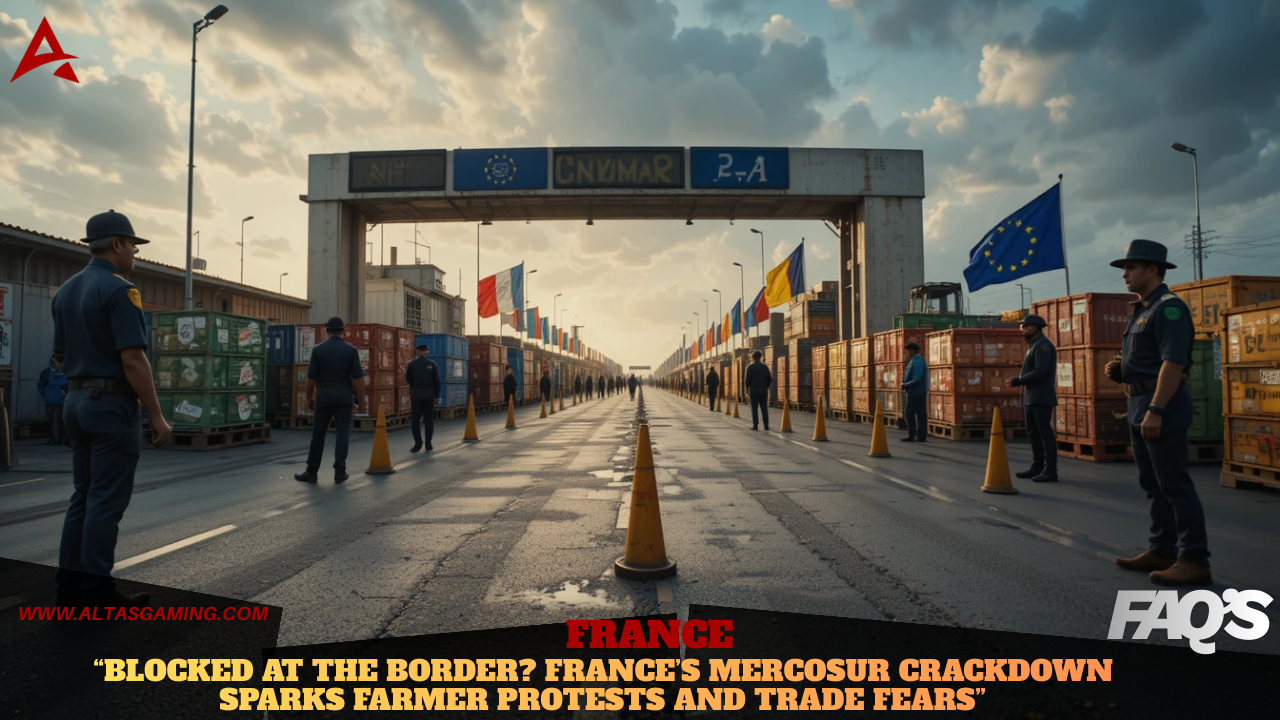
Mercosur Trade Tensions Escalate, France Moves to Block South American Imports Over EU Standards

Introduction
France has drawn a firm red line in the ongoing debate over the European Union–Mercosur free trade agreement, signaling that South American agricultural products failing to meet European standards will not be allowed into the French market. The announcement comes as farmers’ unions intensify pressure on the government, warning of renewed nationwide mobilizations just weeks before the trade deal is expected to be officially signed in January.
At the center of the controversy are food safety, environmental rules, and banned substances, with Paris insisting that European farmers cannot compete on an uneven playing field. The move has broad implications not just for agriculture, but also for EU trade policy, geopolitical relations with Latin America, and global supply chains.
What France Is Blocking – And Why It Matters
The French government has confirmed that it will suspend imports from South America containing substances banned under EU law, even if those products are permitted in their countries of origin.
Key concerns include.
- Pesticides and chemicals prohibited in Europe but still used in parts of Brazil, Argentina, Uruguay, and Paraguay
- Environmental standards, particularly deforestation-linked agriculture
- Animal welfare regulations that differ sharply from EU requirements
French Defense Minister Sébastien Lecornu summed up the government’s stance in an open letter that echoed farmers’ demands:
“The same standards for everyone, the same controls for everyone.”
This principle has become the rallying cry for agricultural unions across France.
Farmers’ Anger and the Threat of Renewed Protests
French farmers, already strained by rising costs, climate volatility, and tighter EU regulations, view the Mercosur agreement as an existential threat.
Why farmers are furious.
- South American producers often face lower regulatory costs
- EU farmers must comply with strict environmental and health rules
- Imports could undercut prices without meeting the same obligations
Agricultural unions are set to meet the Prime Minister early this week and have warned that blockades, demonstrations, and nationwide protests could resume if France does not harden its opposition to the deal.
With memories of recent tractor protests still fresh, the government is under intense political pressure.
The EU–Mercosur Deal, What’s at Stake

The EU–Mercosur trade agreement aims to create one of the world’s largest free trade zones, covering over 700 million consumers. It would significantly reduce tariffs on:
- Beef
- Poultry
- Sugar
- Soy
- Ethanol
While exporters and industrial sectors see opportunity, agriculture remains the most contentious area.
France has long been one of the deal’s strongest critics, arguing that trade liberalization must not come at the cost of food safety, environmental integrity, or rural livelihoods.
Geopolitical and Economic Implications
1. Strained EU–South America Relations
Blocking imports could provoke retaliatory measures or diplomatic friction, particularly with Brazil, which views the agreement as a strategic economic priority.
2. Internal EU Divisions
France’s hard stance highlights deep fractures within the EU, as countries like Germany and Spain support the deal, while France, Ireland, and Austria remain skeptical.
3. Supply Chain Disruptions
If enforcement tightens, European markets may see:
- Short-term price pressures on meat and feed
- Reduced availability of certain agricultural commodities
- Increased sourcing from EU or compliant third countries
Christmas Season Timing Adds Political Pressure
The timing is sensitive. With Christmas holidays approaching, any supply disruption or price increase risks public backlash. Governments are eager to avoid:
- Food inflation spikes
- Retail shortages
- Renewed farmer blockades during peak travel periods
This makes January’s formal signing window particularly volatile.
 ltas Opinion, A Trade Deal at a Crossroads
From an Altas perspective, France’s position reflects a broader global shift: trade agreements are no longer judged solely on economic growth, but on fairness, sustainability, and sovereignty.
While Mercosur promises economic gains, ignoring regulatory asymmetry risks:
- Eroding public trust
- Undermining domestic producers
- Fueling political instability
France’s demand for “equal standards” is not protectionism it is a test of whether globalization can adapt to higher ethical and environmental expectations.
If the EU cannot reconcile these contradictions, the Mercosur deal may survive on paper but struggle in practice.
What Happens Next, Outlook and Forecast
- Short term (weeks): Farmer protests likely intensify
- January signing: Political resistance may delay or fragment ratification
- Medium term: Expect tighter import controls, inspections, and traceability rules
- Long term: EU trade policy may increasingly favor “values-based trade”
FAQ’s
Q1: Is France completely banning Mercosur imports?
No. France is targeting specific products that do not comply with EU standards, particularly those involving banned substances.
Q2: Can France block imports on its own within the EU?
While trade policy is EU-level, France can impose national enforcement measures, inspections, and safeguard clauses under health and safety rules.
Q3: Why is agriculture the main issue in the Mercosur deal?
Because agriculture combines price sensitivity, food safety, environmental impact, and rural livelihoods, making it politically explosive.
Q4: Will this affect food prices in Europe?
Possibly in the short term, especially for beef and animal feed, but long-term effects depend on sourcing shifts and enforcement scope.
Q5: Could the Mercosur agreement still collapse?
Yes. Without unanimous political support and public acceptance, ratification remains uncertain despite years of negotiations.
Final Thoughts
France’s decision to block non-compliant South American imports marks a decisive moment for European trade policy. As farmers demand fairness and governments juggle geopolitics, economics, and public trust, the Mercosur deal stands at a fragile crossroads.
The coming weeks may determine whether Europe reshapes global trade on its own terms or faces renewed internal division over the cost of open markets.
Table of Contents
- Iran War 2026 What Happened and Why Is It Important?
- Helldivers 2 Ultimate Survival Guide: Best Weapons, Builds, Missions & Pro Tips (2026)
- The PlayStation 6 – Everything Gamers Have Been Waiting For – Specs, Power, Features, and the Future of PS Gaming
- Global Crisis 2026 – The New World Order? How Nations Are Reshaping Global Power and Economy- What Happens After the Dollar Era?
- The Witcher 3: Wild Hunt – The Fantasy Masterpiece That Redefined Open-World RPGs

Clutch GM41 Lightweight V2 Gaming Mouse
Clutch GM41 Lightweight V2 Gaming Mouse
About this item
- Fast and Accurate Optical Sensor
- RGB Mystic Light Effect Mode
- Light Weight Gaming Mouse
- 16000 DPI
- Durable Build Quality with OMRON Switches
-
From the manufacturer


Product information
Additional Information
Customer Reviews 4.5 out of 5 stars
Best Sellers Rank - #5,938 in Video Games (See Top 100 in Video Games)
- #282 in PC Gaming Mice
Warranty & Support
Amazon.com Return Policy:You may return any new computer purchased from Amazon.com that is “dead on arrival,” arrives in damaged condition, or is still in unopened boxes, for a full refund within 30 days of purchase. Amazon.com reserves the right to test “dead on arrival” returns and impose a customer fee equal to 15 percent of the product sales price if the customer misrepresents the condition of the product. Any returned computer that is damaged through customer misuse, is missing parts, or is in unsellable condition due to customer tampering will result in the customer being charged a higher restocking fee based on the condition of the product. Amazon.com will not accept returns of any desktop or notebook computer more than 30 days after you receive the shipment. New, used, and refurbished products purchased from Marketplace vendors are subject to the returns policy of the individual vendor.Manufacturer’s warranty can be requested from customer service. Click here to make a request to customer service.
Leave a Reply