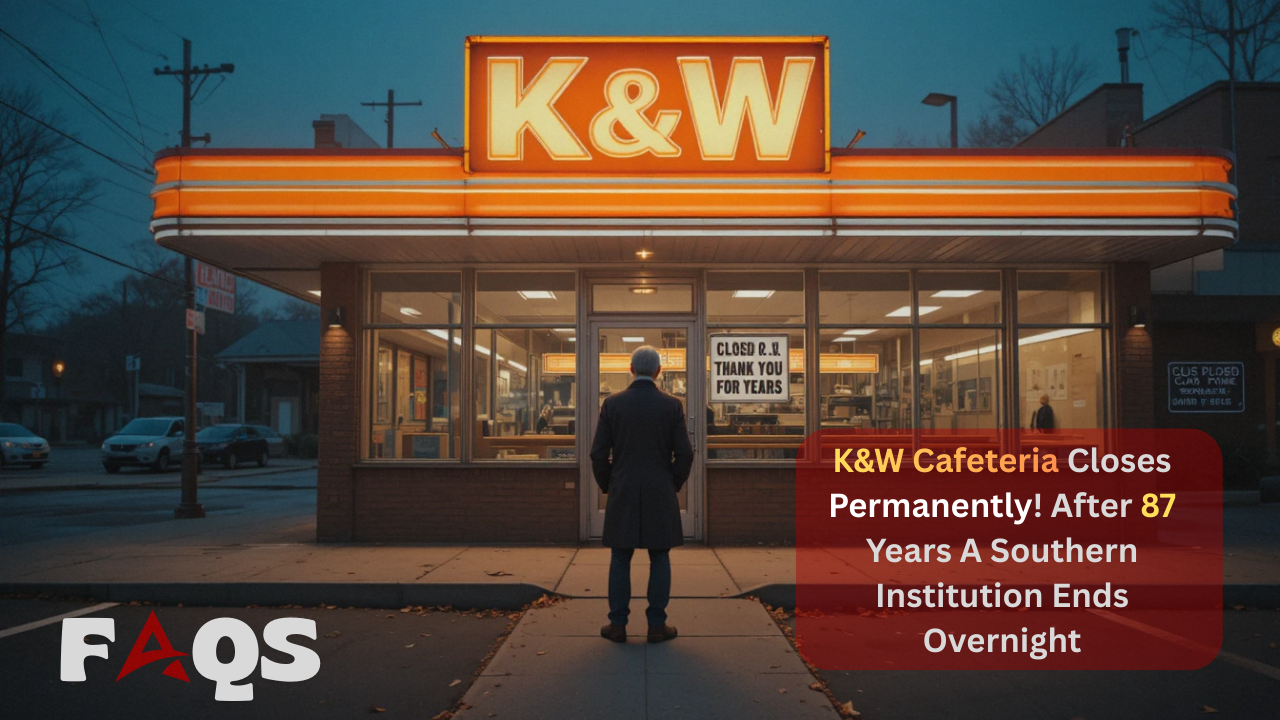
K&W Cafeteria Closes Permanently! After 87 Years A Southern Institution Ends Overnight
After serving generations of families across the Carolinas and Virginia, K&W Cafeteria founded in 1937 has officially closed all locations, effective immediately.
The announcement stunned longtime customers, employees, and the broader restaurant industry, as the cafeteria chain had survived the Great Depression, World War II, recessions, rising supply costs, and competition from modern fast-casual dining.
This week’s abrupt decision confirms what many feared
one of the South’s last major cafeteria-style dining institutions has reached the end of its 87-year journey.
A Legacy Stretching Back to 1937
K&W began in Winston-Salem, North Carolina, started by Grady Allred Sr. who purchased a struggling eatery and transformed it into one of America’s most beloved cafeteria dining experiences.
For decades, the brand became synonymous with
- hand-carved turkey dinners
- scratch-made pies
- trays sliding down polished metal rails
- multigenerational families gathered after church
- senior-friendly pricing
- warm Southern hospitality
At its peak, K&W operated 30+ locations and fed millions annually.
To many Southerners, K&W wasn’t just a place to eat it was a ritual, a memory, a taste of home.
The Sudden Shutdown A Shockwave Across the Region
According to multiple reports, K&W Cafeterias announced the closure immediately, giving customers and many employees no time for a final visit.
In an official statement, the company cited
- years of declining foot traffic
- persistent post-pandemic inflation
- rising labor costs
- supply chain pressures
- inability to compete with fast-casual and delivery-driven dining trends
The closure included all remaining locations at once, marking one of the most abrupt restaurant shutdowns in recent regional history.
Employees across North Carolina and Virginia reported that they learned of the closure the same day it was announced, with some locations locking doors midday.
The Downfall How a Cafeteria Legend Reached a Breaking Point
1. The Post-COVID Foot Traffic Problem
Dining patterns dramatically changed after 2020. Cafeterias with their reliance on seniors, large families, and in-person service suffered disproportionately.
2. Labor Costs Outpaced Revenue
Wages climbed faster than K&W’s traditional pricing model allowed. The cafeteria format, which requires a large kitchen staff, became financially unsustainable.
3. Younger Generations Shifted to Fast-Casual
Chains like Chipotle, Panera, Chick-fil-A, and Raising Cane’s captured the younger demographic K&W struggled to attract.
4. Inflation Hammered the Menu
Operating a cafeteria that offers dozens of daily scratch-made options became expensive and raising prices risked alienating loyal senior customers.
5. No Strong Digital Transition
Unlike modern brands, K&W
- had limited delivery partnerships
- lacked strong mobile ordering
- did not modernize ambience or branding
The result: a timeless experience that didn’t evolve with a digital-first economy.
“It Feels Like Losing a Family Member” Community Reaction
Social media erupted instantly after news broke.
Common themes
- nostalgia for Sunday meals
- sadness about losing family traditions
- concern for longtime employees
- disbelief at the sudden announcement
Many described K&W as a “Southern cultural landmark.”
One customer wrote
“K&W was where my grandparents took me as a kid. I’m heartbroken we didn’t get one last meal.”
Economic Impact A Quiet but Significant Loss
While K&W wasn’t a national chain, its closure affects
- hundreds of employees facing sudden unemployment
- local suppliers who depended on K&W’s high-volume orders
- retail plazas losing their anchor tenants
- senior communities losing one of the most affordable fresh-cooked dining options
Economists note that cafeteria-style restaurants are becoming rare nationwide, with K&W’s collapse signaling the final chapter of a once-standard American dining format.
What Happens Next?
For Customers
Refund policies for gift cards, prepaid meals, or catering orders have not yet been publicly clarified.
For Employees
Workers across stores are awaiting guidance regarding compensation, severance, or potential job placements.
For Locations
Most K&W buildings are large, multi-room restaurant spaces difficult to repurpose quickly. Expect
- redevelopment into medical or retail
- sales to local chains
- long vacancies in weaker markets
The End of an American Era
With K&W Cafeteria now closed permanently, the U.S. loses one of its last family-oriented, cafeteria-style dining chains a format once central to American life.
For countless families, this closure is more than a business headline.
It feels like the closing of a chapter in Southern culture itself.
 ltas Opinion Why the K&W Closure Hurts More Than Most Restaurant Shutdowns
K&W wasn’t simply a “business casualty.”
It was an institution built on community, routine, and generational memory. While many restaurants close yearly, K&W represented something America is losing quickly

The local, slow-dining tradition where community comes before profit.
Its demise reflects a larger trend
- Chains with heritage are being replaced by trendy, tech-driven, convenience-focused brands.
- The U.S. dining landscape is shifting toward fast casual, drive-through, and delivery apps.
- Businesses built on consistent, low-cost, homestyle meals are being squeezed hardest by rising costs.
Altas’ take
K&W’s closure marks the end of a uniquely American dining culture one that newer generations may never experience again.
FAQs
1. Why didn’t K&W Cafeteria sell its recipes or branding before closing?
The company has historically guarded its recipes, and internal sources suggest there was no buyer willing to acquire both the menu and the aging cafeteria-style infrastructure.
2. Could K&W ever return as a smaller, fast-casual brand?
Technically yes but insiders say the cafeteria-style identity is too baked into the brand to be reimagined as a Chipotle-style model without losing its essence.
3. What will happen to the iconic K&W neon signs and vintage cafeteria equipment?
Most will likely be auctioned to commercial buyers, though collectors have expressed interest in preserving signage as historical pieces.
4. Did younger customers impact the decline?
Yes. Millennials and Gen Z overwhelmingly prefer customization, quick service, and digital ordering areas where K&W struggled to adapt.
5. Could a celebrity chef revive K&W as a nostalgia-driven brand?
Possible, but unlikely. Reviving cafeteria-style service would require major modernization costs without promising returns.
6. Why didn’t K&W pivot to meal-prep kits or frozen grocery items?
The chain explored these options in 2021–2022 but found that packaging homestyle meals at scale produced inconsistent quality.
7. Which K&W item was the most expensive to produce?
Surprisingly: the scratch-made yeast rolls, due to labor-intensive prep and rising butter/flour costs.
Table of Contents
- Resident Evil Requiem Becomes 2026’s Highest-Rated Game – A Survival Horror Masterpiece or an Overhyped Sequel That Loses Steam?
- Black Ops 7 Sets a New Standard for Tactical FPS Combat – But Controversy and Matchmaking Frustrations Spark Debate
- Ghostrunner 2 Free on Epic Games, A Cyberpunk Masterpiece of Relentless Action – or a Brutally Punishing Game That’s Too Hard to Love?
- Code Vein II Is a Beautiful Evolution – But Its Uneven World Holds It Back! Or Does It Still Lack the Crown? (Feb 2026)
- Nioh 3 Review- A Brutal Soulslike Masterpiece That Perfects Samurai Combat – Or an Unforgiving Grind That Pushes Players Too Far?

GravaStar Mercury M2 Wireless Gaming Mouse with 26,000 DPI, PAW3395DM Sensor -79g Lightweight Hollowed-Out Design -5 Programmable Buttons -5 Dynamic Lightsync RGB
| Brand | GravaStar |
| Color | Transparent Black |
| Connectivity Technology | Bluetooth, Wi-Fi, USB |
| Special Feature | Wireless, Programmable Buttons, Rechargeable, Ergonomic Design, LED Lights |
| Movement Detection Technology | Laser |
Leave a Reply