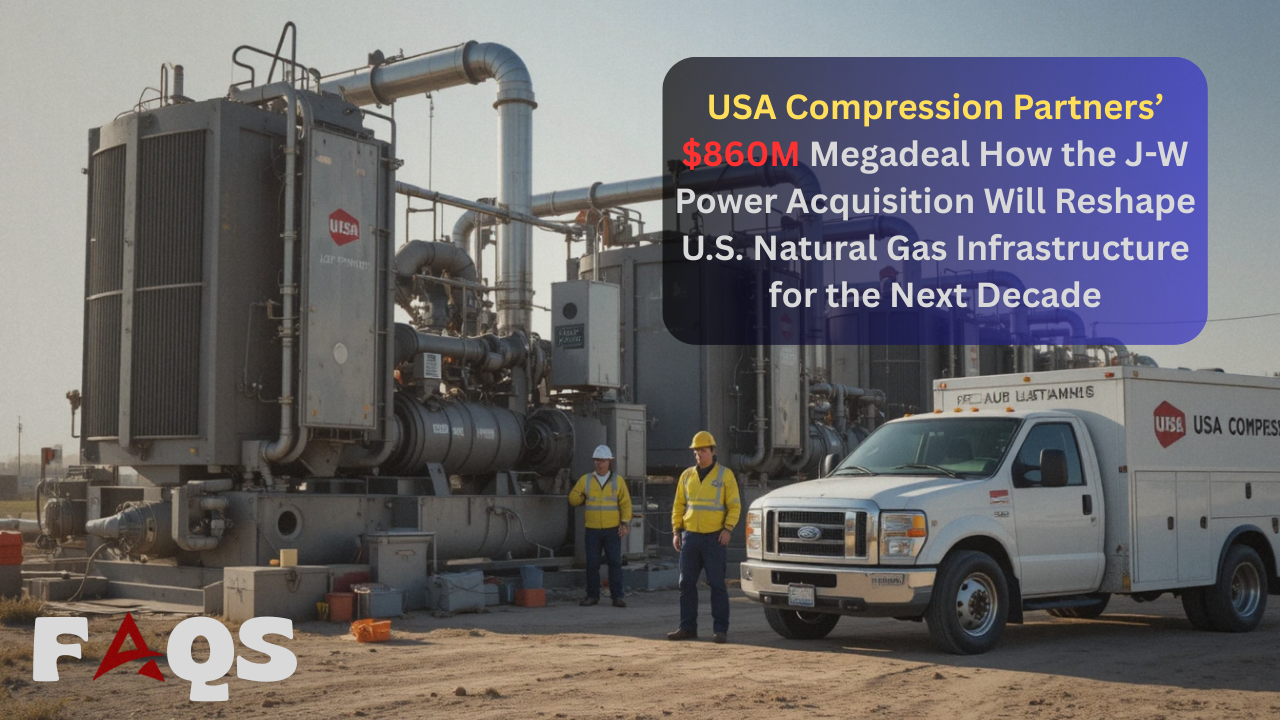
USA Compression Partners’ $860M Megadeal How the J-W Power Acquisition Will Reshape U.S. Natural Gas Infrastructure for the Next Decade
USA Compression Partners LP (USAC) has entered 2026 with one of the boldest strategic moves in the midstream energy sector: the $860–$869 million acquisition of J-W Power Company, one of the nation’s most established compression services providers. This deal isn’t just another consolidation play it is a structural shift with long-lasting consequences for natural gas transportation, shale economics, and U.S. LNG export capacity.
For an industry built on horsepower, uptime, and reliability, the merger of two of America’s largest compression fleets marks a potential turning point for the midstream backbone that keeps natural gas flowing across the country.
The Bigger Picture Why Compression Matters More Than Ever in 2026
Most consumers never think about compression, yet every cubic foot of natural gas they use whether for electricity, heating, or industrial production has been pushed through pipelines by massive compression engines. These units are the beating heart of the gas supply chain.
Compression Is the Engine Behind:
- Moving natural gas through interstate pipelines
- Gathering gas at the wellhead in shale basins
- Feeding LNG export terminals
- Supporting petrochemical facilities
- Maintaining pressure in mature gas fields
And with U.S. natural gas output near record high especially in the Permian, Haynesville, and Appalachia compression capacity is in critical demand.
Three seismic forces are driving growth:
1. LNG Export Boom
By 2027, the U.S. will likely be the world’s #1 LNG exporter, requiring massive compression volumes for sustained feedstock flows.
2. High Decline Rates in Shale Wells
The older a shale well becomes, the more compression it needs to maintain production.
3. Aging Pipeline Infrastructure
Many pipelines were built decades ago and require newer, larger, more efficient compressors.
USAC’s acquisition of J-W Power is directly aligned with all three trends.
What J-W Power Brings to the Table And Why USAC Wanted It
J-W Power Company is not a small acquisition it is a multi-generational industry leader.
Key Assets USAC Gains:
- A major high-horsepower fleet, focused on units above 1,000 HP
- A nationwide service network with experienced technicians
- Modern equipment and proprietary controls technology
- Long-term contracts with well-capitalized customers
- Strategic positions in gas-rich basins, especially the Permian and Eagle Ford
For USAC, this is an immediate scale boost, but also a quality boost more horsepower, more revenue, more uptime, and more modern engines.
Most Important Gain: High-Horsepower Dominance
High-horsepower compression units (HHP) are where the money is. They:
- Command longer contracts
- Have higher margins
- Are essential for large midstream systems
- Are more difficult for competitors to enter
This deal makes USAC one of the strongest HHP operators in North America.
Financial Anatomy of the Deal Why $860M Makes Sense
USAC isn’t buying hype; it’s buying cash flow, stable contracts, and mission-critical equipment in an industry with exceptionally high barriers to entry.
Why the price tag is justified
1. High Utilization Rates
Compression providers often run at 85–95% utilization, making them consistent, predictable revenue generators.
2. Long-Term Take-or-Pay Contracts
These ensure revenue regardless of gas volumes.
3. Minimal Fleet Redundancy
J-W’s fleet complements USAC’s without excessive overlap.
4. High Replacement Cost
Building an equivalent HHP fleet today would cost significantly more due to:
- Engine shortages
- Labor constraints
- Steel and manufacturing cost inflation
USAC is effectively buying assets below modern replacement cost, which makes this deal financially strategic.
Impact on the Midstream Landscape A New Powerhouse Emerges
This acquisition consolidates two of the few remaining compression providers capable of national-scale deployment.
Immediate Industry Impacts
- USAC becomes a top-tier HHP compression giant
- Competitors face pressure to scale or risk losing relevance
- Producers benefit from stronger service reliability
- Midstream operators gain a more capable supplier
In a market where uptime is everything, large standardized fleets have a massive advantage.
How This Deal Affects U.S. Natural Gas Markets
1. Support for LNG Buildout
More compression = more guaranteed throughput to export terminals.
2. Increased Takeaway Capacity
Basin bottlenecks may ease in regions like:
- Permian
- Haynesville
- Anadarko
- Appalachia
3. Reduced Flaring Pressure
Proper compression allows operators to capture more gas instead of burning it off.
4. Improved Pipeline Efficiency
Modern compressors have lower fuel costs and fewer emissions.
Risks & Challenges USAC Will Need to Manage
No megadeal is risk-free.
Key challenges include:
1. Integrating Two Large Fleets
Different engine types, parts inventories, and service systems must be unified.
2. Labor Shortages
Experienced compression technicians are in high demand nationwide.
3. Maintenance Cost Inflation
Compressor rebuilds and overhauls are expensive and require specialized expertise.
4. Natural Gas Price Volatility
Although compression is insulated, extreme downturns can indirectly affect demand.
 ltas Opinion The Real Strategic Play Behind the Scenes
Here is the deeper takeaway:

This deal signals a long-term bet that natural gas will remain America’s cornerstone energy source through 2040 and beyond.
USAC didn’t spend $860M to win the next two years it spent it to dominate the next two decades.
My analysis:
1. Compression demand will only rise
More LNG → more pipelines → more persistence of shale → more compression.
2. USAC becomes nearly impossible to compete with at scale
This creates a strong defensive moat.
3. The deal positions USAC for future acquisitions
This may trigger a consolidation wave across the industry.
4. Investors should view this as a cash-flow multiplier
Compression companies often operate like “energy REITs” with stable, contract-based income.
USAC’s strategy is clear: control the horsepower, and you control the flow.
FAQs
1. Will this deal change the price producers pay for compression?
Likely not immediately, but USAC’s scale could eventually stabilize or standardize pricing across certain basins.
2. Will J-W Power’s brand name disappear?
Most likely. USAC tends to fold acquired assets under its own unified branding for operational efficiency.
3. Could this deal lead to fewer compression choices in remote basins?
Yes some small regional providers may lose market share as USAC expands coverage.
4. How quickly will the fleets be integrated?
Industry norm is 18–30 months, though partial integration begins immediately.
5. Could this deal accelerate emissions-reduction projects?
Absolutely modern USAC/J-W fleets can upgrade to lower-emission engines faster due to scale.
6. Is this deal a sign that USAC is preparing for an LNG supercycle?
Yes. Compression is foundational to LNG feedstock stability, and this acquisition anticipates rising volumes.
Table of Contents
- Oil, Gold, Silver, Crypto & War 2026 The Complete Story From Beginning to Now
- Is World War 3 coming Iran–Israel–USA Conflict 2026 The Complete Story, Hidden Tensions, and What Could Happen Next
- Taiwan Invasion by 2027 – But the Real War for AI, Chips, and Global Power Has Already Begun
- Resident Evil Requiem Becomes 2026’s Highest-Rated Game – A Survival Horror Masterpiece or an Overhyped Sequel That Loses Steam?
- Black Ops 7 Sets a New Standard for Tactical FPS Combat – But Controversy and Matchmaking Frustrations Spark Debate

Leave a Reply