
The PlayStation 5 just received an important graphics upgrade, and you do not need a PS5 Pro to benefit from it.
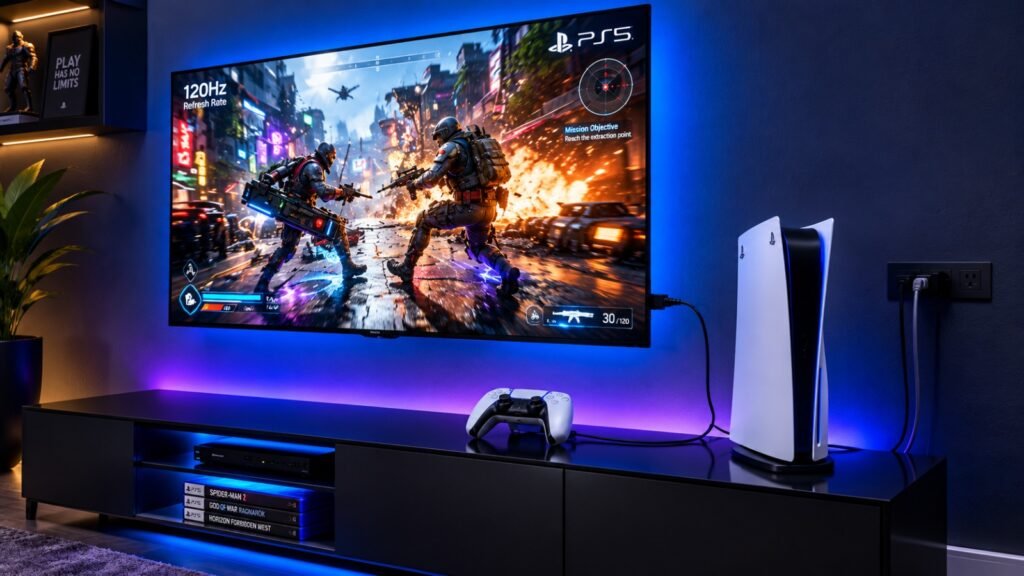
Sony has introduced Quick Spectral Super Resolution, or QSSR, a new AI upscaling technology designed specifically for the standard PS5. The technology is intended to improve image detail and stability while helping games deliver a better balance between visual quality and performance.
The first games to use QSSR are Marvel’s Wolverine and Ghost of Yōtei, both of which received patches adding QSSR as an additional graphics option on PS5.
This development is particularly interesting because Sony previously introduced PlayStation Spectral Super Resolution (PSSR) as an important feature of the more powerful PS5 Pro. QSSR is designed to bring some of the benefits of AI-assisted image reconstruction to the standard PS5 while requiring less computational power.
So, what exactly is QSSR, how does it work, and what could it mean for PS5 gaming in the future?
1. What Is Sony’s QSSR AI Upscaling Technology?
QSSR stands for Quick Spectral Super Resolution.
It is an AI-guided upscaling technology developed by Sony Interactive Entertainment as a performance-focused evolution of its PSSR technology.
Instead of simply rendering every frame at the highest possible resolution, AI upscaling analyzes the game image and reconstructs additional visual detail. The goal is to produce a sharper and more stable image while reducing some of the rendering workload.
Sony says QSSR was created using a streamlined neural network architecture and a hand-tuned implementation designed to maximize performance on the PS5.
This means QSSR is not simply a software switch that magically makes every game run at a higher resolution. Developers need to implement the technology into their games.
For players, however, the potential benefit is simple: better image quality without requiring a more expensive console.
2. QSSR Brings AI Upscaling to the Standard PS5
The biggest part of this announcement is that QSSR is designed for the base PS5.
Sony’s PSSR technology was introduced with PS5 Pro and uses AI to analyze game images pixel by pixel during the upscaling process. According to Sony, the computational demands of PSSR previously made it impractical to bring the same experience to the standard PS5.
QSSR takes a different approach.
Sony describes it as a new performance tier of AI upscaling that uses a more streamlined neural network and an implementation specifically optimized for PS5 hardware.
This gives the standard PS5 a new way to improve image quality without needing the additional processing power available in the PS5 Pro.
For millions of existing PS5 owners, that makes the announcement particularly significant.
3. Marvel’s Wolverine Is One of the First Games to Use QSSR
Marvel’s Wolverine is one of the first games to receive QSSR support.
The game was developed by Insomniac Games and features detailed environments, characters and effects that can benefit from improved image reconstruction.
According to Insomniac’s technology team, QSSR adds more pixel-level clarity and stability to environments in the game, including busy streets and detailed locations.
That is important because modern games contain enormous amounts of visual information.
Fine details such as buildings, foliage, character features, signs and distant objects can become less stable when a game is rendered at a lower internal resolution.
AI upscaling attempts to reconstruct these details more intelligently.
The result is intended to make the image appear sharper and more stable while maintaining the performance characteristics developers are targeting.
4. Ghost of Yōtei Also Gets QSSR
Ghost of Yōtei is the second launch title for QSSR.
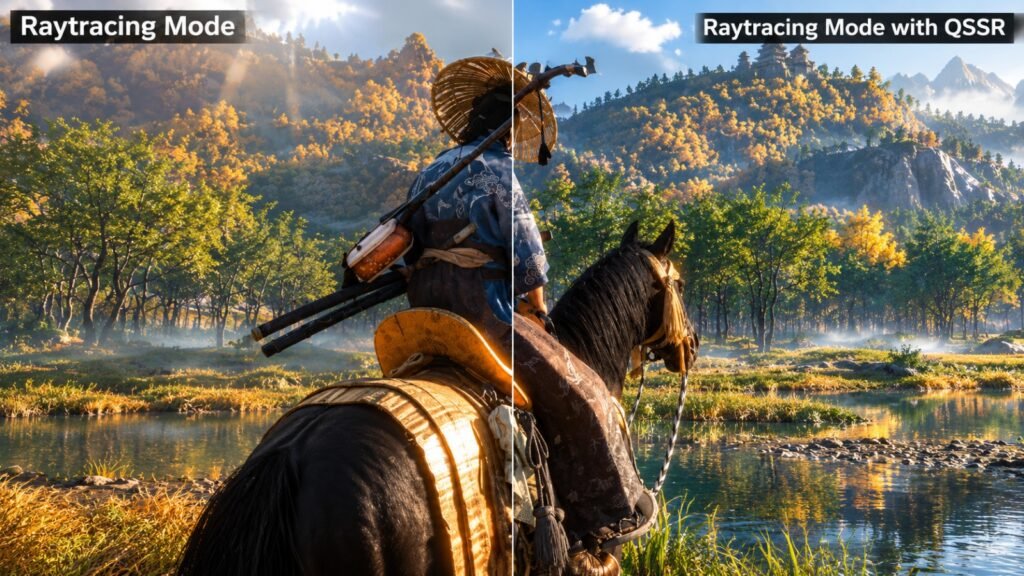
Sucker Punch Productions has also added the technology to the PS5 version of the game, giving players another example of how AI upscaling can be used in a visually demanding open world.
Sucker Punch’s rendering team says QSSR can improve the clarity and temporal stability of fine details in characters and environments.
This is particularly relevant for a game such as Ghost of Yōtei, where landscapes, vegetation, character details and environmental effects are important parts of the visual experience.
The technology does not replace the game’s graphics engine. Instead, it works as part of the rendering process to reconstruct the final image.
That distinction is important because QSSR is not a new graphics mode by itself. It is a technology developers can use to improve how the final image is produced.
5. How Is QSSR Different From PSSR?
QSSR and PSSR are closely related, but they are not exactly the same technology.
PSSR, or PlayStation Spectral Super Resolution, was introduced on PS5 Pro and is designed to take advantage of the console’s additional processing capabilities.
Sony says PSSR analyzes game images pixel by pixel and uses AI to upscale them with improved detail and stability compared with conventional approaches.
QSSR takes a more performance-focused approach.
Sony describes PSSR as the higher-end solution on PS5 Pro, while QSSR is designed to provide notable improvements on the standard PS5.
In simple terms:
PS5 Pro: PSSR
Standard PS5: QSSR
The two technologies share the same broader idea of using AI-assisted image reconstruction, but they are optimized for different hardware capabilities.
6. Will QSSR Increase FPS on PS5?
This is where things become more complicated.
QSSR is primarily an AI upscaling and image-quality technology, so it should not be described as a guaranteed FPS boost for every PS5 game.
The benefit depends on how a developer implements it and how the game’s rendering pipeline is configured.
AI upscaling can allow developers to render certain parts of a game at a lower internal resolution and reconstruct the image to produce a sharper final result.
That can potentially create more room in the performance budget for other graphical features or help developers balance image quality and frame rate.
However, players should not expect every QSSR-supported game to suddenly run at dramatically higher FPS.
The actual experience will depend on the game’s graphics modes, resolution targets, frame-rate targets and implementation.
Sony’s announcement focuses on improvements to image detail and stability, rather than promising a universal frame-rate increase.
7. Why AI Upscaling Matters for Console Gaming
AI upscaling has become an increasingly important technology in modern gaming.
Games are becoming more detailed, environments are getting larger, and players expect higher image quality while also wanting smooth performance.
Rendering every frame at native high resolution can put significant pressure on hardware.
Upscaling provides another option.
Instead of asking the GPU to render everything at the highest resolution, developers can use reconstruction technologies to produce a high-quality final image from a lower-resolution source.
PC gamers may already be familiar with technologies such as NVIDIA DLSS, AMD FSR and Intel XeSS.
Sony’s QSSR and PSSR follow the same broad industry trend: using advanced reconstruction techniques to achieve a better balance between performance and visual quality.
For consoles, this can be particularly useful because the hardware configuration is fixed.
Developers know exactly what hardware players have, allowing them to optimize their games around specific systems.
8. More PS5 Games Could Use QSSR in the Future
Perhaps the most important part of Sony’s announcement is that QSSR is not limited to the first two games.
Sony says QSSR will be offered broadly to PlayStation developers and expects more games to make use of the technology in the future.
That could make QSSR much more significant over time.
The first two games demonstrate the technology, but its real impact will become clearer as more developers integrate it into their rendering systems.
Future PS5 games could potentially use QSSR to improve image stability, reconstruct fine details and create better visual quality within the limitations of the standard hardware.
This could be especially useful for large open world games and visually demanding titles where developers need to carefully balance resolution, graphics quality and performance.
9. Does This Make the PS5 Pro Less Important?
Not necessarily.
The PS5 Pro still has more powerful hardware and remains Sony’s higher-performance console.
Sony itself describes PSSR as the higher-end solution for PS5 Pro, while QSSR is a performance-focused technology designed.
The new technology should therefore not be viewed as turning a standard PS5 into a PS5 Pro.
Instead, QSSR gives developers another tool to extract better image quality from existing PS5 hardware.
For someone who already owns a standard PS5, that is good news.
You do not necessarily need to upgrade your console to benefit from advances in Sony’s graphics technology.
As more developers adopt QSSR, existing PS5 owners could see visual improvements in supported games without purchasing new hardware.
10. What Does QSSR Mean for the Future of PS5 Gaming?
QSSR could become an important part of the next stage of PS5 gaming.
Sony has already shown that AI-assisted reconstruction can play a major role in improving image quality on PS5 Pro through PSSR. Now, the company is bringing a more performance-focused version of that approach to the standard PS5. The bigger story, however, will be what happens next.
If more developers adopt QSSR, players could see increasingly sophisticated image reconstruction across a wider range of games.
That could help developers push visual quality further while working within the limits of existing PS5 hardware.
Final Thoughts
Sony’s introduction of QSSR AI upscaling for PS5 is a meaningful update for existing PlayStation owners.
The technology brings an AI-assisted approach to image reconstruction that was previously associated with Sony’s PS5 Pro through PSSR.
While QSSR does not mean that every PS5 game will suddenly receive a huge FPS boost, it gives developers another tool for improving image detail, clarity and stability while balancing performance.
Marvel’s Wolverine and Ghost of Yōtei are the first games to support QSSR, but Sony says the technology will be made broadly available to PlayStation developers.
That makes the future more interesting.
The standard PS5 may be several years into its life cycle, but technologies such as QSSR show that developers can still find new ways to improve the visual experience without requiring players to immediately upgrade their hardware.
For PS5 owners, the message is simple: your console just got a little smarter.
Table of Contents

Leave a Reply