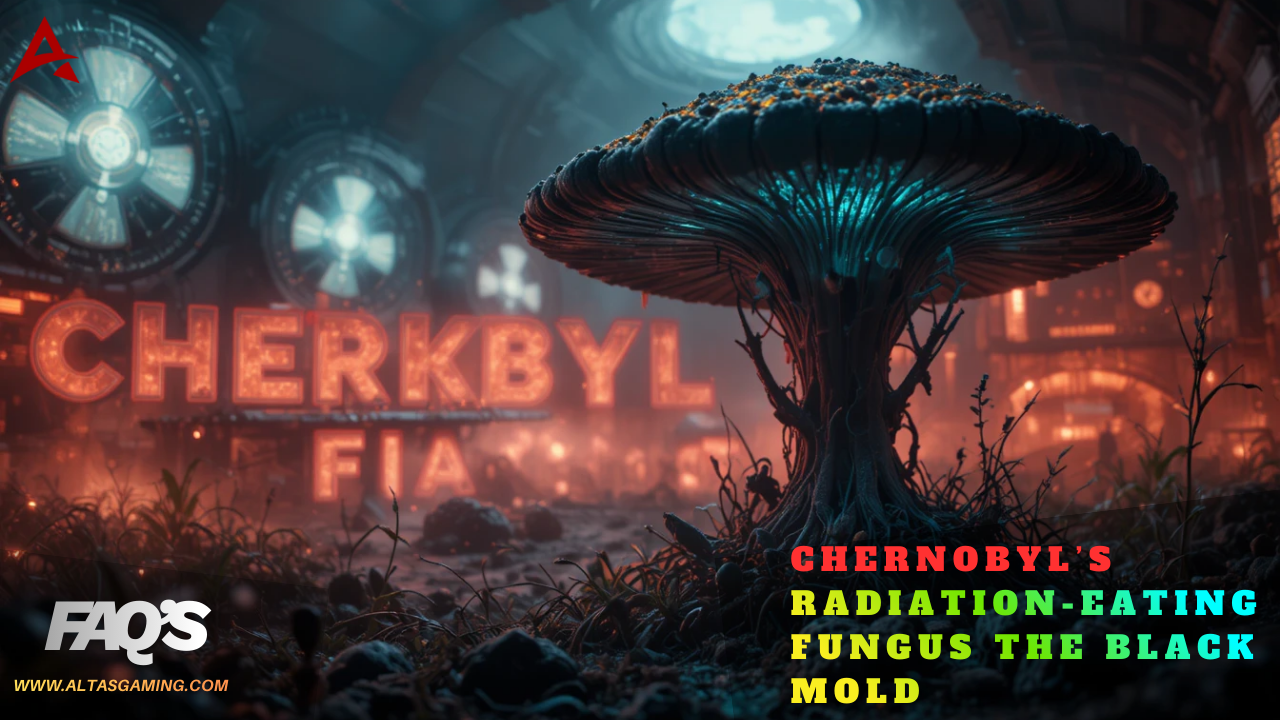
Chernobyl’s Fungus Appears to Have Evolved an Incredible Ability Could Radiation-Eating Life Be Key to Space and Nuclear Cleanup 2025
Description
A mysterious black fungus from Chernobyl seems to harvest ionizing radiation as energy. Explore what scientists know and don’t know about its remarkable adaptation, potential for space colonization, and real-world limitations.
Introduction
In the radioactive ruins of the 1986 disaster at Chernobyl, humanity expected death. Instead, nature surprised us. Deep inside the reactor and its environs, scientists observed a strange, dark fungus later identified as Cladosporium sphaerospermum (and related melanized fungi) growing on walls and surfaces exposed to intense ionizing radiation. (Forbes)
Even more astonishing: under laboratory experiments, this fungus appeared to thrive in radiation raising the possibility that rather than being destroyed by radiation, some life forms might use it. This challenges long-held assumptions about radiation and life, offering tantalizing implications for nuclear clean-up, biology, and even future space travel. In this article, we examine what is known so far, what remains unproven, and where this discovery might lead along with Altas’s view.
What Is Radiotrophic Fungus & Where It Was Found
- Radiotrophic fungi are species capable of harnessing ionizing radiation as an energy source, akin to how plants use sunlight via photosynthesis. The pigment melanin the same pigment that darkens skin, hair, or fungus appears to play a central role. (Wikipedia)
- At Chernobyl and other high-radiation zones, over 200 species of melanized fungi were discovered in the reactor room walls and surrounding contaminated soil. (Wikipedia)
- Among them, C. sphaerospermum drew particular attention for seeming to not only survive but grow better when exposed to ionizing radiation. (ScienceAlert)
How the Fungus Might “Eat” Radiation Science Behind the Phenomenon
- Laboratory experiments showed that when melanized fungi like C. sphaerospermum (and others such as Cryptococcus neoformans, or melanized yeasts) are exposed to ionizing radiation, their metabolic activity increases compared to non-melanized strains or to background radiation. (pmc.ncbi.nlm.nih.gov)
- The working hypothesis: melanin absorbs radiation (gamma, ionizing) and may facilitate an electron-transfer process, turning some of that energy into a form usable by the fungus a process sometimes called radiosynthesis. (Wikipedia)
- This process resembles photosynthesis in concept (radiation instead of light; melanin instead of chlorophyll), though scientists stress that full biochemical pathways such as carbon fixation from inorganic carbon driven by radiation have not yet been demonstrated. (ScienceAlert)
- In a study aboard the International Space Station (ISS), radiotrophic fungi were tested under space radiation, showing potential for reducing radiation penetration beneath a thin fungal layer suggesting use as a biological radiation shield. (Wikipedia)
Why This Discovery Matters Potential Applications
🌍 Environmental Remediation & Nuclear Cleanup
If radiotrophic fungi can survive, accumulate radioisotopes, or stabilize radioactive byproducts, they might be used to clean up contaminated nuclear zones a “biological buffer” where conventional methods struggle. (RSD Journal)
🛡️ Radiation Shield for Space Travel
Cosmic radiation poses a major risk for astronauts on long-term missions. Scientists propose that a fungal layer or melanin-based materials inspired by these fungi could help shield spacecraft or habitats, converting dangerous ionizing radiation into harmless waste or even usable energy. (Wikipedia)
🧪 Understanding Life’s Limits Biology & Evolution
The existence of radiotrophic life challenges our understanding of what environments are “inhospitable.” It suggests that life can adapt even thrive under extreme ionizing radiation, reshaping our definitions of habitable zones on Earth and beyond.
What We DON’T Know Key Scientific Uncertainties
- No verified energy-gain pathway: While metabolic stimulation under radiation is observed, scientists have not demonstrated full carbon fixation analogous to photosynthesis. In other words we don’t yet know if the fungus truly “eats” radiation in the sense of converting it into biomass energy sustainably. (ScienceAlert)
- Not all melanized fungi behave same: Some species show increased melanin production under radiation, but may not show growth or metabolic gains. The ability seems limited to certain strains. (ScienceAlert)
- Practical limitations: Using fungi as radiation shields or waste digesters raises many challenges containment, rate of growth, long-term stability, radiation saturation, genetic stability, and unpredictability of real-world radiation environments.
- Health & ecological risks: Introducing such fungi or their spores outside controlled labs could pose unknown ecological or health risks. Much remains unknown about side-effects, mutation under radiation, toxicity, or long-term effects.
 ltas Opinion Cautious Optimism

I believe the story of Chernobyl’s radiation-eating fungi is one of the most fascinating in modern biology. It shows nature’s resilience and potential for adaptation way beyond what was once imaginable.
However and this is important it remains extremely speculative. The term “radiation-eating” may sound like science fiction, but to date we lack conclusive proof that these fungi can sustainably convert radiation into biomass or energy the way plants use sunlight.
For now, they should be viewed as a promising lead, not a guaranteed solution. The real value lies in research potential for nuclear cleanup, radiation shielding, and perhaps future bioengineering. If properly studied, controlled, and regulated, these fungi (or melanin-based derivatives) could become valuable tools.
But jumping to conclusions on “fungal-powered space ships” or “self-cleaning nuclear reactors” is premature. Responsible science demands patience, rigorous study, and careful risk assessment.
FAQ’s.
Q1: Can we eat these fungi if they “eat radiation”?
A: Absolutely not no credible research supports them being safe for consumption. Because they thrive in radioactive environments, they likely accumulate radioisotopes; consuming them would be extremely dangerous.
Q2: Could melanin from these fungi be extracted and used as a radiation-blocking material (like shielding clothing or paint)?
A: In theory yes melanin’s radiation-absorbing traits are what make these fungi interesting. Some researchers propose melanin-infused materials or coatings to shield against radiation (in space or nuclear zones). But practical, safe, scalable melanin-based shielding remains hypothetical.
Q3: If fungi reduce radiation exposure under a thin layer (like on ISS), does that mean they neutralize radioactivity?
A: No. Experiments showed a modest reduction in radiation penetration under a thin fungal layer but that doesn’t neutralize or eliminate radiation. It’s more akin to a “shield,” not a “radiation-eating vacuum cleaner.”
Q4: Could such fungi be used to clean nuclear waste sites like Chernobyl or Fukushima safely?
A: Potentially, but with great caution. While radiotrophic fungi may accumulate radioactive particles or survive high radiation, using them would require containment, monitoring of mutation risks, and safe disposal. At present, this remains a research proposal, not a proven cleanup method.
Q5: Is this a sign that life could exist on highly radioactive planets or moons like in sci-fi stories?
A: It hints at possibility. If life on Earth can adapt to extreme radiation, it broadens our conception of “habitable.” But radiation is only one of many harsh conditions lack of atmosphere, temperature extremes, pressure, nutrients must all be considered. So while inspiring, this is no guarantee of alien fungal forests.
Conclusion
The discovery of radiation-adaptive fungi at Chernobyl especially melanized species like Cladosporium sphaerospermum stands as a remarkable testament to life’s resilience and adaptability. What began as survival in a toxic wasteland now offers hope: for bioremediation, radiation shielding, and new frontiers in biology.
Yet, we are only at the door of understanding. The “radiation-eating fungus” remains a tantalizing hypothesis rather than a proven tool. Its potential is huge but so are the scientific, practical, and ethical questions.
In my view: treat this as a scientific breakthrough under investigation, not a ready-made solution. Support research. Encourage responsible innovation. But avoid hype and unrealistic expectations.
Table of Contents
- Iran War 2026 What Happened and Why Is It Important?
- Helldivers 2 Ultimate Survival Guide: Best Weapons, Builds, Missions & Pro Tips (2026)
- The PlayStation 6 – Everything Gamers Have Been Waiting For – Specs, Power, Features, and the Future of PS Gaming
- Global Crisis 2026 – The New World Order? How Nations Are Reshaping Global Power and Economy- What Happens After the Dollar Era?
- The Witcher 3: Wild Hunt – The Fantasy Masterpiece That Redefined Open-World RPGs
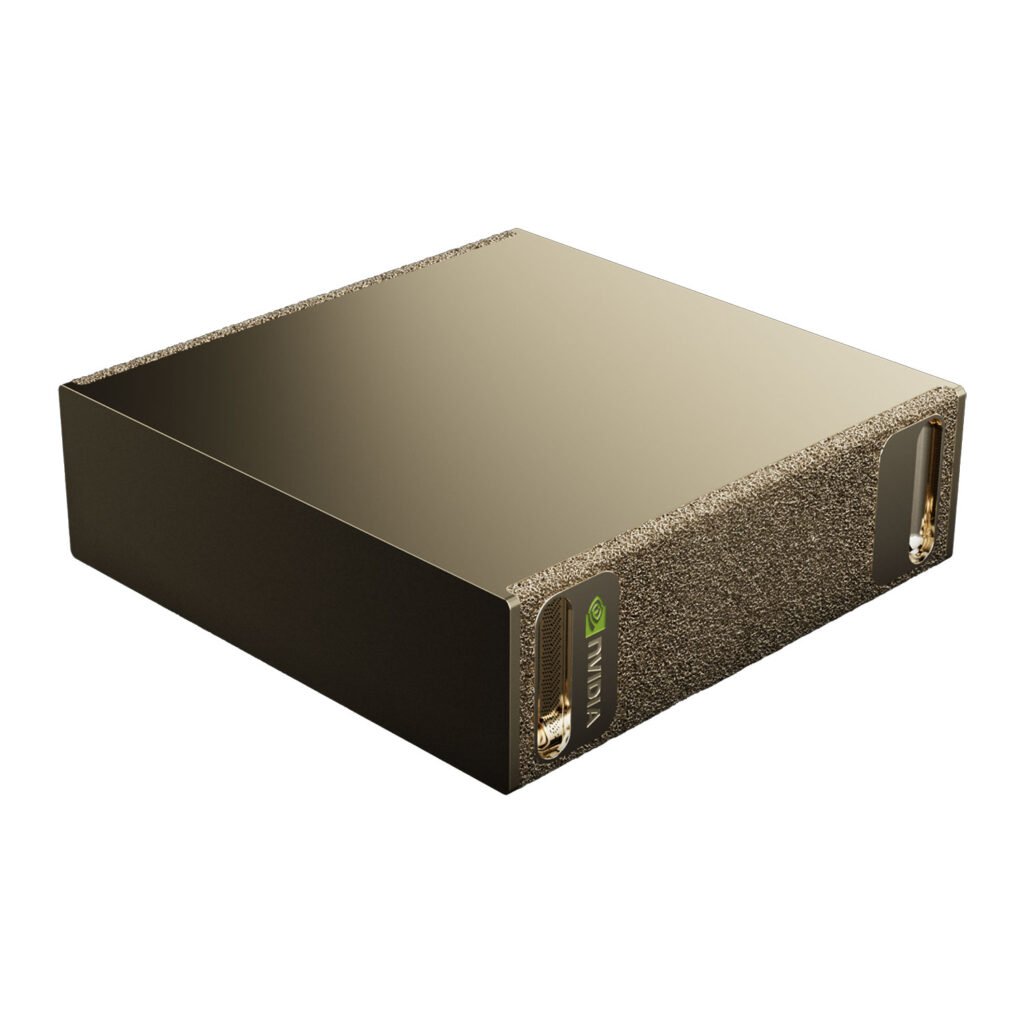
NVIDIA DGX Spark Personal AI Supercomputer
Accelerate All AI Workloads
DESKTOP AI COMPUTE DEMANDSThe increasing size and complexity of generative AI models is making development efforts on local systems challenging. Prototyping, tuning, and inferencing large models locally requires large amounts of memory and significant compute performance. As enterprises, software providers, government agencies, startups, and researchers staff up AI efforts, the need for AI compute resources continues to grow.
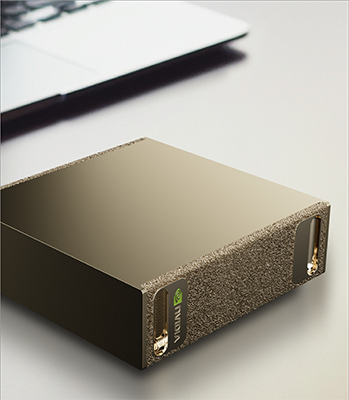
200B PARAMETER MODELS ON YOUR DESKNVIDIA DGX™ Spark is part of a new class of computers designed from the ground up to build and run AI. Powered by the NVIDIA GB10 Grace Blackwell Superchip and based on the NVIDIA Grace Blackwell architecture, NVIDIA DGX Spark delivers up to 1000 TOPS of AI performance to power large AI workloads. With 128 GB of unified system memory, developers can experiment, fine-tune, or inference models of up to 200B parameters. Plus, NVIDIA ConnectX™ networking can connect two NVIDIA DGX Spark supercomputers to enable inference on models up to 405B parameters.
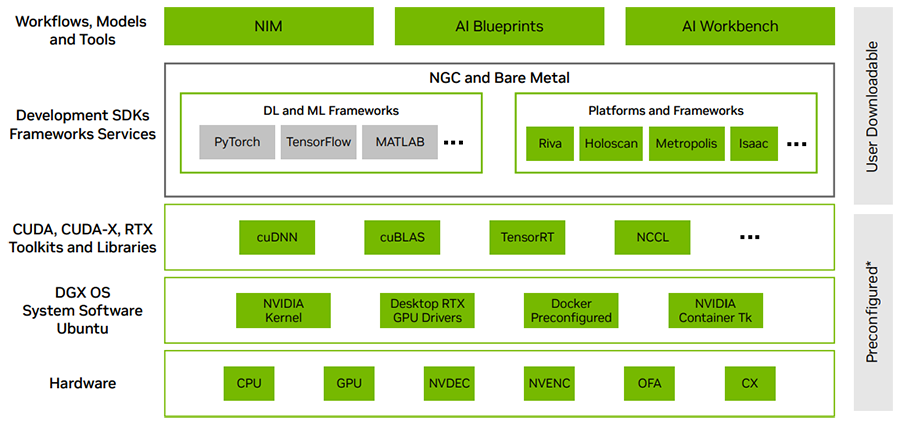
To give developers a familiar experience, NVIDIA DGX Spark mirrors the same software architecture that powers industrial-strength AI factories. Using the NVIDIA DGX OS with Ubuntu Linux and preconfigured with the latest NVIDIA AI software stack, along with developer program access to NVIDIA NIM™ and NVIDIA Blueprints, developers can hit the ground running using common tools such as Pytorch, Jupyter, and Ollama to prototype, fine-tune, and inference on NVIDIA DGX Spark and seamlessly deploy in the data centre or cloud.
WORK WITH LARGE-PARAMETER AI MODELSWith 128 GB of unified system memory and support for the FP4 data format, NVIDIA DGX Spark can support AI models of up to 200B parameters, enabling AI developers to prototype, fine-tune, and inference large models on their desktop. With builtin NVIDIA ConnectX network technology, two NVIDIA DGX Spark systems can be connected to work on even larger models such as Llama 3.1 405B.
NVIDIA GPU, CPU, Networking, and AI Software Technologies

BUILT ON NVIDIA GRACE BLACKWELLAt the heart of NVIDIA DGX Spark is the new NVIDIA GB10 Grace Blackwell Superchip based on the NVIDIA Grace Blackwell architecture optimised for a desktop form factor. GB10 features a powerful NVIDIA Blackwell GPU with fifth-generation Tensor Cores and FP4 support, delivering up to 1000 TOPS of AI compute. GB10 includes a high-performance Grace 20-core Arm CPU to supercharge data preprocessing and orchestration, speeding up model tuning and real-time inferencing. The GB10 Superchip uses the NVLink™-C2C to deliver a CPU+GPU coherent memory model with 5X the bandwidth of PCIe Gen 5.
 NVIDIA GB10 SUPERCHIPExperience up to 1000 AI TOPS of AI performance at FP4 precision with the NVIDIA Grace Blackwell architecture.
 128 GB OF COHERENT UNIFIED SYSTEM MEMORYRun AI development and testing workloads with AI models up to 200 billion parameters at your desktop with large, unified system memory.
 NVIDIA CONNECTX NETWORKINGHigh-performance NVIDIA Connect-X networking enables connecting two NVIDIA DGX Spark systems together to work with AI models up to 405 billion parameters.
 NVIDIA AI SOFTWARE STACKUse a full-stack solution for generative AI workloads, including tools, frameworks, libraries, and pretrained models.
Connect Two DGX Systems

CONNECTX-7 SMART NICUpgrade easily by Connecting two DGX Spark systems together via ConnectX-7 and LinkX cable to work with even larger models of up to 405 billion parameters utilising the full 256GB of unified memory for better than multi-GPU workstation performance*
*Assuming 4-bit precision and workloads specific to high memory usage models. See comparison table for more information
Develop Locally, Deploy Anywhere at Scale
WORKFLOW, MODELS AND TOOLSDGX Spark comes with all the software AI developers need to get up running AI workloads right away. Users can install their favourite tools, and frameworks or take advantage of the latest NVIDIA workflows, models, microservices and tools such as NVIDIA NIM, AI Blueprints or AI Workbench.
Learn more about:
NVIDIA FRAMEWORKS
A New Era of Performance

Wi-Fi, Bluetooth, USB
NCCL, RDMA, GPUDirect
1 PetaFLOP FP4 AI Compute
20 Arm Cores
128 GB Low Power DDR5X
Learn more about:
NVIDIA DGX SPARK
NVIDIA DGX Spark Specifications
| Architecture | NVIDIA Grace Blackwell |
| GPU | NVIDIA Blackwell Architecture |
| CPU | 20 core Arm, 10 Cortex-X925 + 10 Cortex-A725 Arm |
| CUDA Cores | NVIDIA Blackwell Generation |
| Tensor Cores | 5th Generation |
| RT Cores | 4th Generation |
| Tensor Performance | 1000 AI TOPS |
| System Memory | 128 GB LPDDR5x, unified system memory |
| Memory Interface | 256-bit |
| Memory Bandwidth | 273 GB/s |
| Storage | 4 TB NVME.M2 with self-encryption |
| USB | 4x USB TypeC |
| Ethernet | 1x RJ-45 connector – 10 GbE |
| NIC | ConnectX-7 Smart NIC |
| Wi-Fi | WiFi 7 |
| Bluetooth | BT 5.3 |
| Audio-output | HDMI multichannel audio output |
| Power Supply | 240W |
| GB10 TDP | 140W |
| Display Connectors | 1x HDMI 2.1a |
| NVENC | NVDEC | 1x | 1x |
| OS | NVIDIA DGX™ OS |
| System Dimensions | 150 mm L x 150 mm W x 50.5 mm H |
| System Weight | 1.2 kg |
Leave a Reply