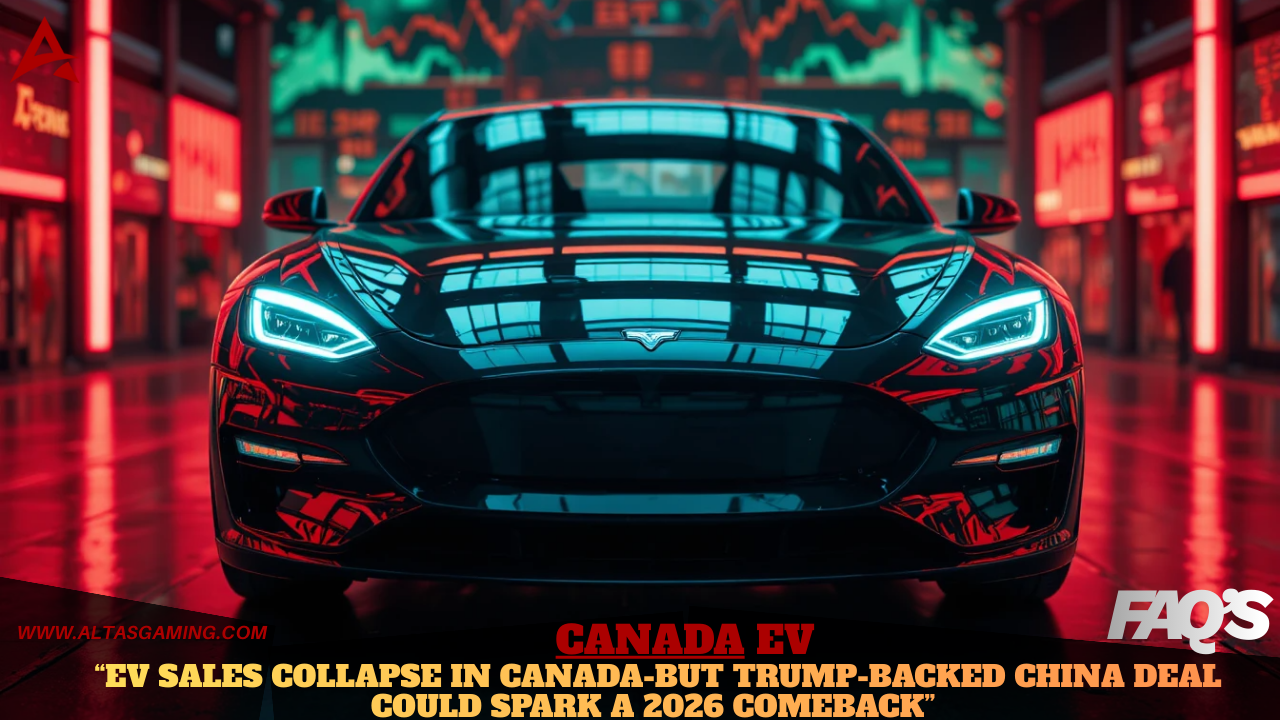
⚡ Why Trump Backed Canada’s China Deal-and How Chinese EVs Could Reshape Canada’s Auto Market

Donald Trump surprisingly endorsed Canada’s China deal as Ottawa eyes Chinese EVs to revive a collapsing market.
🌍 A Surprising Endorsement in a Tense Global Moment
In a move that raised eyebrows across Washington and Ottawa, Donald Trump publicly endorsed Canada’s recent deal with China, even as U.S.–China relations remain strained by tariffs, technology disputes, and strategic rivalry.
The endorsement comes amid:
- Canada’s push to stabilize trade with Beijing
- Growing interest in Chinese electric vehicles (EVs)
- A dramatic collapse in Canada EV sales in 2025
- A global EV boom that is accelerating everywhere-except Canada
This is not just about cars. It’s about geopolitical positioning, economic survival, and who controls the next phase of clean transportation.
🤝 Why Did Trump Support Canada’s Deal With China?
At first glance, Trump backing a China deal seems contradictory. But the logic is strategic.
Key reasons behind Trump’s stance:
- Testing a Detente Model
Canada’s engagement with Beijing offers a low-risk way to observe whether limited economic cooperation can reduce tensions without full concessions. - Pressure Valve for U.S.–China Relations
A successful Canada–China framework could give Washington a template for selective engagement with President Xi Jinping, particularly in non-military sectors. - Keeping China Close, Not Isolated
Trump has repeatedly argued that pushing allies into economic corners only drives them deeper into China’s orbit.
🇨🇦 “A Great Day for Canadians”: Saskatchewan Premier Reacts
Saskatchewan’s premier hailed the China tariff deal as “a great day for Canadians,” citing:
- Reduced export pressure on Canadian resources
- Improved trade stability for agriculture and manufacturing
- A chance to counter slowing domestic demand
For resource-rich provinces, access to Chinese markets remains economically vital regardless of global tensions.
⚖️ Carney’s EV Deal With Beijing- High-Wire Diplomacy
Mark Carney’s involvement in shaping Canada’s EV strategy with China has been described as “high-wire diplomacy” and for good reason.
The risks:
- U.S. backlash over Chinese tech access
- National security concerns around data and supply chains
- Domestic political resistance
The rewards:
- Affordable EVs for Canadian consumers
- Revived EV adoption
- Industrial competition and pricing pressure on legacy automakers
Canada is attempting to balance Washington’s security concerns with its own economic reality.
🚗 Chinese EVs Are Coming to Canada-Sooner Than Expected

Industry experts say Chinese EVs could arrive in Canada sooner than many expect, possibly as early as late 2025 or early 2026, depending on regulatory approvals.
Expected pricing:
- Entry-level models could undercut Western EVs by 20–40%
- Potential starting prices well below CAD $30,000
- Advanced features often included as standard
Popular Chinese brands are known for:
- Competitive battery technology
- Fast charging
- Software-first design
For cost-sensitive Canadian buyers, this could be a game-changer.
📉 Why Canadian EV Sales Collapsed in 2025
While global EV adoption broke records in 2025, Canada was a major exception.
Key reasons EV sales “fell off a cliff”:
- High interest rates
- Expensive EV pricing
- Reduced government incentives
- Limited charging infrastructure growth
In contrast, EV adoption accelerated in:
- China
- Europe
- Parts of the U.S.
- Emerging Asian markets
Canada’s market stalled precisely when affordability mattered most.
🔮 Could Chinese EVs Revive Canada’s EV Market in 2026?
Many analysts believe yes but with conditions.
Why revival is possible:
- Lower prices could reignite demand
- Increased competition forces price cuts
- Consumers prioritize value over brand loyalty
Why risks remain:
- Tariff uncertainty
- U.S. pressure on Canada
- Public concern over data security
Still, without Chinese competition, Canada risks falling permanently behind in EV adoption.
🌐 Trade, Tariffs & the Bigger Geopolitical Picture
This EV debate sits at the crossroads of:
- U.S.–China rivalry
- Clean energy transition
- Supply chain nationalism
Trump’s endorsement reflects a pragmatic view:
Trade isolation has consequences, especially for allies.
Pushing Canada away from China entirely could weaken not strengthen North American economic resilience.
🎙️  lta’s Opinion

Canada is stuck between principle and practicality.
On one hand, aligning too closely with China carries undeniable risks.
On the other, ignoring economic reality could stall Canada’s EV transition for years.
My view:
- Chinese EVs are not a threat they’re a stress test
- If Western automakers can’t compete on price and value, that’s a market failure not foreign aggression
Trump’s endorsement signals something deeper:
Even hardline politics bends when economic gravity becomes too strong.
❓ FAQ’s
Q1. Why would Trump support a China deal involving Canada but not the U.S.?
Because it allows indirect engagement without political cost at home.
Q2. Are Chinese EVs banned in the U.S.?
Not officially, but tariffs and regulations make entry extremely difficult.
Q3. Could Chinese EVs threaten Canadian auto jobs?
Short-term pressure is possible, but competition can also drive innovation and job transformation.
Q4. Will Chinese EVs qualify for Canadian EV incentives?
That remains unclear and will depend on future policy decisions.
Q5. Why is Canada lagging in EV adoption while others surge?
Affordability, incentives, and infrastructure not consumer interest are the main barriers.
Q6. Could the U.S. retaliate if Canada deepens EV ties with China?
Political pressure is possible, but outright retaliation is unlikely given trade interdependence.
Q7. What’s the biggest hidden risk in Chinese EV adoption?
Data governance and software security not hardware quality.
🧾 Final Takeaway
Canada’s EV dilemma is not about choosing sides it’s about choosing progress.
Trump’s endorsement of Canada’s China deal underscores a quiet truth:
Economic realities eventually overpower ideology.
If handled carefully, Chinese EVs could revive Canada’s stalled EV market in 2026.
If mishandled, Canada risks being left behind in a global transition that won’t wait.
Table of Contents
- Helldivers 2 Ultimate Survival Guide: Best Weapons, Builds, Missions & Pro Tips (2026)
- The PlayStation 6 – Everything Gamers Have Been Waiting For – Specs, Power, Features, and the Future of PS Gaming
- Global Crisis 2026 – The New World Order? How Nations Are Reshaping Global Power and Economy- What Happens After the Dollar Era?
- The Witcher 3: Wild Hunt – The Fantasy Masterpiece That Redefined Open-World RPGs
- Diablo 4: Lord of Hatred Complete Guide – Story, Classes, Endgame & Secrets

Clutch GM41 Lightweight V2 Gaming Mouse
Clutch GM41 Lightweight V2 Gaming Mouse
About this item
- Fast and Accurate Optical Sensor
- RGB Mystic Light Effect Mode
- Light Weight Gaming Mouse
- 16000 DPI
- Durable Build Quality with OMRON Switches
-
From the manufacturer


Product information
Additional Information
Customer Reviews 4.5 out of 5 stars
Best Sellers Rank - #5,938 in Video Games (See Top 100 in Video Games)
- #282 in PC Gaming Mice
Warranty & Support
Amazon.com Return Policy:You may return any new computer purchased from Amazon.com that is “dead on arrival,” arrives in damaged condition, or is still in unopened boxes, for a full refund within 30 days of purchase. Amazon.com reserves the right to test “dead on arrival” returns and impose a customer fee equal to 15 percent of the product sales price if the customer misrepresents the condition of the product. Any returned computer that is damaged through customer misuse, is missing parts, or is in unsellable condition due to customer tampering will result in the customer being charged a higher restocking fee based on the condition of the product. Amazon.com will not accept returns of any desktop or notebook computer more than 30 days after you receive the shipment. New, used, and refurbished products purchased from Marketplace vendors are subject to the returns policy of the individual vendor.Manufacturer’s warranty can be requested from customer service. Click here to make a request to customer service.
Leave a Reply