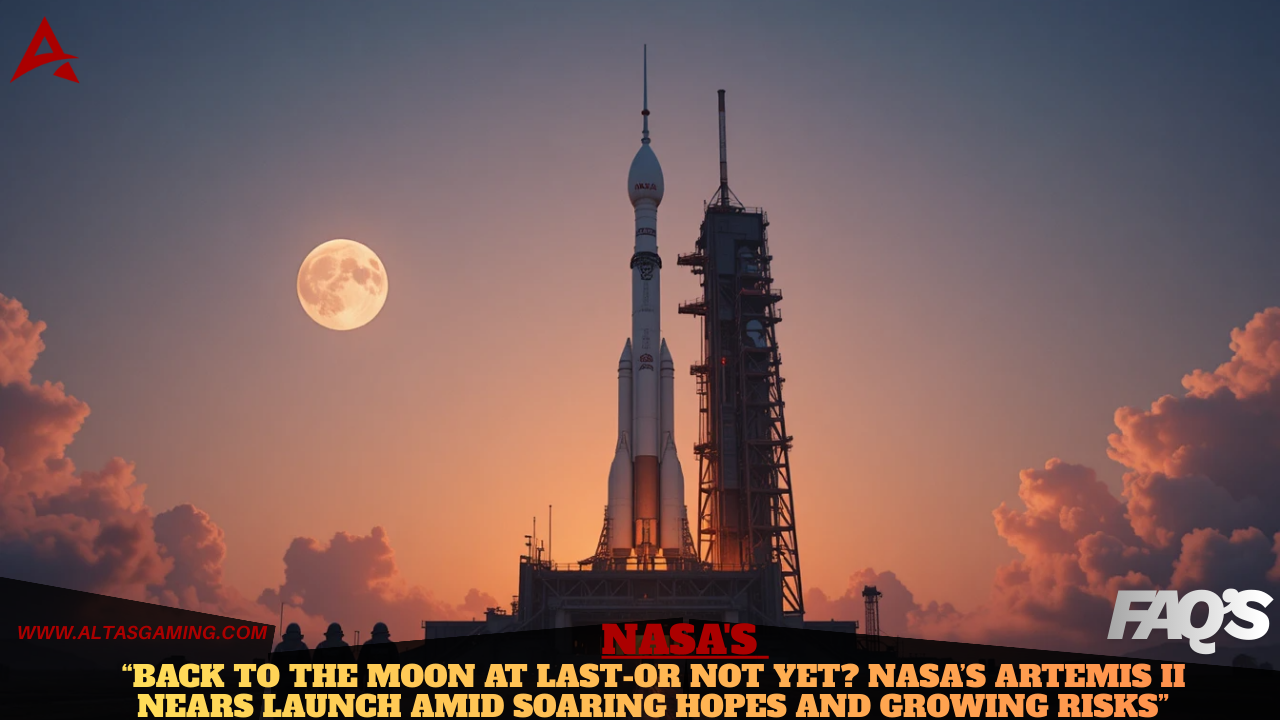
NASA’s Artemis II Moon Mission Moves to Launch Pad- Humanity’s First Crewed Lunar Flyby in 50 Years Signals a New Space Race
Introduction- A Historic Rocket Begins Its Final Crawl
NASA’s mega Moon rocket, the Space Launch System (SLS), has officially arrived at its launch pad, marking a critical milestone for the Artemis II mission the first crewed journey around the Moon in more than half a century. The slow, deliberate rollout signals that humanity is once again preparing to venture beyond low Earth orbit, this time under far more complex scientific, geopolitical, and commercial circumstances than during the Apollo era.
If all proceeds as planned, four astronauts including Canadian Space Agency Astronaut Jeremy Hansen could launch as early as February, embarking on an unprecedented lunar flyby that stops short of landing but carries immense strategic and symbolic weight.
What Is Artemis II” and Why It Matters
Artemis II is NASA’s first crewed Artemis mission, following Artemis I’s uncrewed lunar test flight in 2022. Unlike Apollo missions, Artemis II is not about planting flags it is about testing human deep-space capability for sustained lunar presence and future Mars exploration.
Key Mission Objectives:
- Validate Orion spacecraft life-support systems
- Test navigation, communications, and radiation protection
- Conduct a high-speed lunar flyby
- Prepare systems for Artemis III, which aims to land astronauts on the Moon
This mission is essentially a dress rehearsal for lunar landings, ensuring astronauts can survive prolonged deep-space exposure.
Why Aren’t the Astronauts Landing on the Moon?
A central question many people ask: Why go all the way to the Moon and not land?
The Strategic Reason:
- Artemis II focuses on human safety validation
- Lunar landing systems (including SpaceX’s Starship lander) are still undergoing testing
- NASA is prioritizing risk reduction before committing to surface missions
Unlike Apollo, Artemis missions are part of a long-term lunar architecture, not one-off visits.
Meet the Crew- Four Astronauts on a Historic Path
The Artemis II Crew:
- Reid Wiseman (NASA) – Mission Commander
- Victor Glover (NASA) – Pilot
- Christina Koch (NASA) – Mission Specialist
- Jeremy Hansen (CSA) – Mission Specialist
Why Jeremy Hansen’s Role Is Historic
- First Canadian astronaut to travel to the Moon
- Symbolizes international collaboration
- Reinforces Canada’s role in the Artemis Accords
Hansen’s participation highlights how modern space exploration is no longer dominated by a single nation.
The Rocket- Why NASA’s SLS Is So Important
The Space Launch System is the most powerful rocket ever built, generating 8.8 million pounds of thrust at liftoff.
Why SLS Matters:
- Capable of deep-space human missions
- Designed for heavy payloads
- Central to NASA’s Moon-to-Mars strategy
Despite criticism over cost overruns, SLS remains the backbone of NASA’s human exploration plans.
Geopolitical Stakes- Space Is the New Strategic Frontier
The New Space Race
Artemis II is unfolding amid intensifying global competition:
- China and Russia are advancing their own International Lunar Research Station
- China plans crewed lunar missions by the 2030s
- Space is now viewed as a strategic domain, alongside land, sea, air, and cyberspace
The U.S.-led Artemis program is as much about geopolitical leadership as science.
War, Trade, and Tariff Implications
Why Space Ties into Global Conflict:
- Satellite dominance impacts modern warfare
- Lunar resources (like helium-3) could shape future energy markets
- Space supply chains rely on advanced materials affected by trade restrictions
Sanctions, semiconductor controls, and rare-earth supply tensions indirectly influence space programs, making Artemis a strategic hedge against dependency.
Economic and Commercial Impact
Artemis II supports:
- Tens of thousands of jobs across the U.S., Canada, and Europe
- Private-sector growth through partnerships with SpaceX, Lockheed Martin, and Boeing
- A growing space economy expected to surpass $1 trillion by 2040
This mission reinforces space as a long-term investment, not just exploration.
Risks and Challenges Ahead
Despite optimism, challenges remain:
- Technical risks associated with human deep-space travel
- Budget pressures amid global economic uncertainty
- Political scrutiny over costs and timelines
A delay or failure could have significant reputational and strategic consequences.
Forecast- What Comes After Artemis II?
Near-Term Outlook:
- Artemis II launch window: February
- Artemis III lunar landing: mid-to-late 2020s
- Permanent lunar infrastructure planning underway
Long-Term Vision:
- Sustained human presence on the Moon
- Lunar base camps
- Gateway space station
- Preparation for Mars missions
 ltas Opinion- More Than a Mission -A Statement

From an Altas perspective, Artemis II is less about the Moon and more about leadership. In an era of fragmented global cooperation, space has re-emerged as a platform where alliances, innovation, and power converge.
This mission quietly signals that:
- The U.S. intends to remain the architect of space governance
- International partnerships are preferred over isolation
- The Moon is no longer symbolic it is strategic
FAQ’s
When will Artemis II launch?
NASA is targeting February, though final dates depend on system readiness.
Will the astronauts land on the Moon?
No. Artemis II is a lunar flyby mission only.
Why is this mission historic?
It marks the first crewed lunar journey in over 50 years.
Who is Jeremy Hansen?
A Canadian astronaut and the first non-American to fly to the Moon.
How does this affect global politics?
It reinforces U.S.-led alliances and counters rival lunar ambitions.
Conclusion- Humanity’s Return to Deep Space Begins Again
As NASA’s mega Moon rocket stands at the launch pad, Artemis II represents a defining moment not just for space exploration, but for geopolitics, economics, and humanity’s future beyond Earth. Whether viewed as science, strategy, or symbolism, one thing is clear: the road back to the Moon is officially open again.
Table of Contents
- Iran War 2026 What Happened and Why Is It Important?
- Helldivers 2 Ultimate Survival Guide: Best Weapons, Builds, Missions & Pro Tips (2026)
- The PlayStation 6 – Everything Gamers Have Been Waiting For – Specs, Power, Features, and the Future of PS Gaming
- Global Crisis 2026 – The New World Order? How Nations Are Reshaping Global Power and Economy- What Happens After the Dollar Era?
- The Witcher 3: Wild Hunt – The Fantasy Masterpiece That Redefined Open-World RPGs

Corsair K70 PRO TKL RGB
Corsair K70 PRO
About this item
- Speed is Everything: It’s all about speed. With Rapid Trigger, ultra-fast polling rates, and per-key adjustable switches, K70 PRO TKL removes every barrier that comes between you and gaming greatness
- Space-Saving Tenkeyless Layout: The sleek, streamlined tenkeyless layout fits in nearly every gaming setup, while leaving room for sweeping mouse movements
- MGX Hyperdrive Magnetic Switches*: Pre-lubricated CORSAIR MGX Hyperdrive magnetic switches deliver a smooth, ultra-responsive keypress. Its sturdy double-rail structure reduces wobble and guarantees peak performance for 150 million keystrokes. *Function keys and non-primary keys feature CORSAIR MLX switches
- Rapid Trigger Advantage: Rapid Trigger dynamically changes your keys’ actuation and reset points, so you can move and reset your movements faster than ever
- Customizable Per-Key Actuation: Adjust the actuation point of each key from a super-sensitive 0.4mm to a deep 3.6mm (in 0.1mm steps) or set two actions to a single keypress with dual actuation for quick-fire combos and action pairs.






Leave a Reply