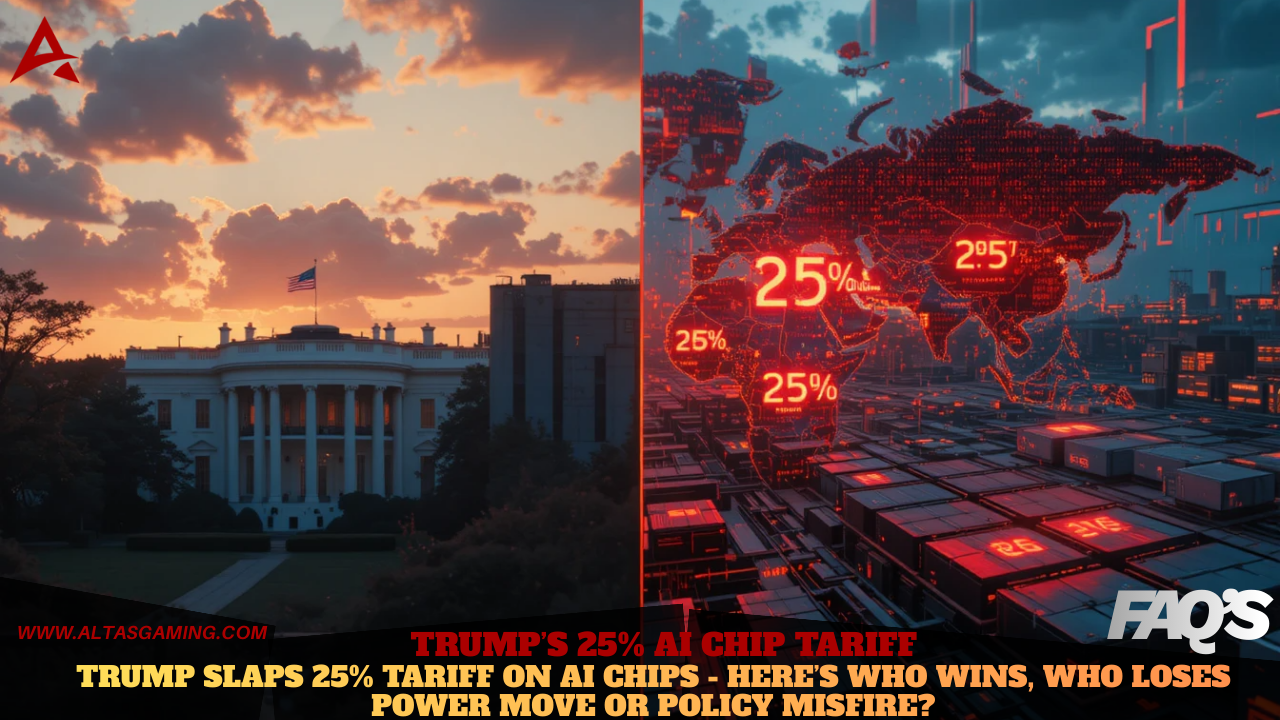
Trump’s 25% AI Chip Tariff- A National Security Shield or a Global Trade Shockwave?
The Trump administration has taken one of its most consequential economic steps yet, imposing a 25% tariff on select advanced artificial intelligence (AI) computing chips, including products from Nvidia, AMD, and other leading semiconductor firms. Framed as a national security measure, the move is already reshaping markets, diplomatic relations, and the future of the global technology supply chain.
This decision follows a nine-month investigation and signals that broader semiconductor tariffs may soon follow, placing the AI industry at the heart of a rapidly intensifying economic and geopolitical confrontation.
But beneath the headlines lies a far more complex story one involving legality, global alliances, energy policy, Middle East tensions, and even the future of American technological dominance.
What the New AI Chip Tariff Does
Under a new presidential proclamation:
- A 25% tariff applies to select advanced AI computing chips
- Targets include high-performance GPUs and accelerators used in:
- Military systems
- Large AI models
- Surveillance and intelligence platforms
- Nvidia and AMD products are explicitly affected
- Broad exemptions are granted for:
- Data centers
- Consumer electronics
- Certain enterprise infrastructure
The White House argues the policy is essential to prevent strategic technologies from indirectly strengthening foreign adversaries, especially in an era where AI capability equals geopolitical power.
Why National Security Is the Official Justification
According to administration officials, AI chips are no longer just commercial products. They are:
- Force multipliers in modern warfare
- Critical to cybersecurity and intelligence analysis
- Central to autonomous weapons systems
The concern is that foreign access direct or indirect to U.S.-designed chips could undermine American security, particularly amid rising tensions with China, Iran, and Russia.
This framing allows the administration to use national security authority, rather than traditional trade law, to justify the tariffs an approach that has sparked fierce legal debate.
“Bamboozled?” Legal Challenges and the Supreme Court
Legal experts and critics argue the tariffs stretch presidential power to its limits.
- Analysts question whether such sweeping tariffs are legal
- Critics say Congress not the White House controls trade
- The U.S. Supreme Court has delayed a ruling on Trump-era tariff authority
- Markets remain on edge, fearing:
- Policy reversals
- Escalating uncertainty
- Long-term damage to rule-based trade
The delay has created a legal gray zone, where businesses must adapt without knowing if the tariffs will ultimately stand.
Markets React- Tech Shaken, Energy Relieved
Semiconductors & AI Stocks
- AI chipmakers face higher costs and pricing pressure
- Cloud providers may delay infrastructure investments
- Innovation timelines could slow due to uncertainty
Oil & Gas- A Different Story
In a parallel move, the administration has adopted a “license-heavy, tariff-light” approach to energy:
- Over a billion acres opened for licensing
- No tariffs on refinery feedstock
- Regulatory burdens sharply reduced
Energy executives say “the regulatory sword has been removed”, giving U.S. oil and gas firms a strategic boost even as tech faces constraints.
Global Fallout- From Tehran to New Delhi
Iran
Secondary tariffs tied to technology and energy trade are already being felt:
- Protests in Iran have escalated
- Analysts warn the regime faces economic suffocation
- AI and semiconductor restrictions further limit Iran’s technological capacity
India
Trump’s suggestion of tariffs as high as 500% has alarmed policymakers:
- Risks a U.S.–India trade freeze
- Could erode India’s export competitiveness
- May push India to deepen trade ties with:
- Europe
- Southeast Asia
- The Middle East
China
Although not named explicitly, Beijing views the move as part of a broader AI containment strategy, reinforcing fears of a permanent technological decoupling.
A Rewired American Empire?
Supporters argue Trump is rewiring global trade to favor:
- Domestic manufacturing
- Strategic autonomy
- National resilience
Critics counter that tariffs:
- Raise costs for U.S. firms
- Invite retaliation
- Risk isolating America technologically
This tension defines the modern U.S. economic dilemma: Can a superpower protect itself without fragmenting the global system it once built?
What Comes Next- Forecast & Scenarios
Short-Term (2025–2026):
- Market volatility remains high
- AI infrastructure investment slows temporarily
- Legal uncertainty persists
Mid-Term:
- More semiconductor tariffs likely
- Increased government subsidies for domestic chipmaking
- Acceleration of “friend-shoring” supply chains
Long-Term:
- A divided AI ecosystem:
- U.S.-aligned tech bloc
- China-led alternative systems
- Higher costs, but greater strategic control
 lta’s Opinion- Protection or Overreach?

This tariff is not about economics alone it’s about power.
Trump’s move acknowledges a reality many policymakers avoided: AI chips are the oil of the 21st century. However, weaponizing trade at this scale carries risks.
The danger isn’t the tariff itself it’s escalation without coordination.
Without allied alignment, the U.S. could slow its own innovation while rivals adapt faster.
Smart defense requires precision, not blunt force.
FAQ’s- What Readers Need to Know
Q1: Will this make AI products more expensive?
Yes, especially enterprise AI services and cloud computing over time.
Q2: Are consumers immediately affected?
Mostly no. Consumer devices and data centers are largely exempt for now.
Q3: Is Nvidia losing dominance?
Not immediately, but margins and global market strategy face pressure.
Q4: Could the tariffs be reversed?
Possibly, depending on Supreme Court rulings and political outcomes.
Q5: Why link AI chips to Iran and geopolitics?
AI capabilities increasingly define military, surveillance, and cyber power.
Q6: Is this the start of a full semiconductor trade war?
All signs suggest yes.
Bottom Line
Trump’s 25% AI chip tariff is a defining moment in the global technology war one that will shape innovation, alliances, and economic power for years to come.
Whether it protects America or fractures the system depends on what comes next.
Table of Contents
- Resident Evil Requiem Becomes 2026’s Highest-Rated Game – A Survival Horror Masterpiece or an Overhyped Sequel That Loses Steam?
- Black Ops 7 Sets a New Standard for Tactical FPS Combat – But Controversy and Matchmaking Frustrations Spark Debate
- Ghostrunner 2 Free on Epic Games, A Cyberpunk Masterpiece of Relentless Action – or a Brutally Punishing Game That’s Too Hard to Love?
- Code Vein II Is a Beautiful Evolution – But Its Uneven World Holds It Back! Or Does It Still Lack the Crown? (Feb 2026)
- Nioh 3 Review- A Brutal Soulslike Masterpiece That Perfects Samurai Combat – Or an Unforgiving Grind That Pushes Players Too Far?
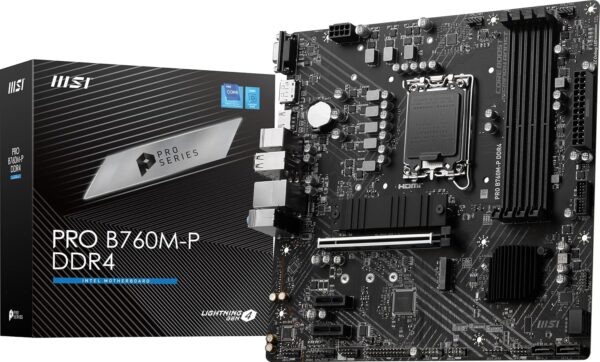
MSI PRO B760M-P DDR4 ProSeries Motherboard
MSI PRO B760M-P DDR4 ProSeries Motherboard
| Brand | msi |
| CPU Socket | LGA 1700 |
| Compatible Devices | Personal Computer |
| RAM Memory Technology | DDR4 |
| Compatible Processors | Intel Core 14th/ 13th/ 12th Gen Processors, Intel Pentium Gold and Celeron Processors |
About this item
- Supports 12th/13th Gen Intel Core, Pentium Gold and Celeron processors for LGA 1700 socket
- Supports DDR4 Memory, Dual Channel DDR4 4800+MHz (OC)
- Core Boost : With premium layout and digital power design to support more cores and provide better performance
- Memory Boost: Advanced technology to deliver pure data signals for the best performance, stability and compatibility
- Lightning Fast Experience: PCIe 4.0, Lightning Gen4 x4 M.2 with M.2 Shield Frozr.
-
From the manufacturer


MSI Business & Productivity
MSI Business & Productivity specializes in home & commercial office computing hardware with a design emphasis on productivity and user comfort.
For business professionals searching for elegant, world class solutions engineered with cutting edge components, premium reliability and refined aesthetics, MSI Business & Productivity offers a broad array of innovative products to ensure a competitive working environment.
PRO B760M-P DDR4
Business Elegance
The PRO B760M-P DDR4 is a business-oriented Micro-ATX motherboard featuring the latest Intel B760 chipset that supports ample RAM capacity.
- Supports Intel Core 12th & 13th Gen Processors (LGA 1700)
- 4 x DDR4 DIMMs with Memory Boost: Dual Channel (128GB Max. / 4800MHz OC)
- 1 x PCIe 4.0 x16 slot
- Lightning Gen4 M.2 & M.2 Shield Frozr
- USB 3.2 Gen 2 Type-C (10Gbps)
- 7.1 HD Audio with Audio Boost
B760 Chipset, Smart Cooling, DDR4 Memory Boost, PCIe 4.0 x16 slot

Supports Intel Core 12th & 13th Gen Processors
The PRO B760M-P DDR4 motherboard supports 12th & 13th Gen Intel Core, Pentium Gold, and Celeron processors.
- Form Factor: Micro-ATX
- Socket Type: LGA 1700
- Chipset: Intel B760

Integrated Cooling Features
- Chipset Heatsink: Provides passive cooling
- SSD Cooling: M.2 Shield Frozr prevents thermal throttling.
- Frozr AI Cooling: Automatically adjusts system fan settings based on CPU & GPU temperatures

4 x DDR4 Dual Channel (4800 MHz OC)*
- Memory Boost: A fully-isolated DDR circuit delivers pure data signals for optimal gaming and overclocking performance.
- XMP profiles in MSI BIOS are MSI OC LAB optimized and can be easily enabled with auto power settings for optimized memory speed and stability.
*1DPC 1R Max. overclocking frequency 4800+ MHz, supports Intel XMP.

Fortified PCIe 4.0 x16
MSI PCI Express Steel Armor slots are secured to the motherboard with extra solder points to support the weight of heavy graphics cards. When every advantage in games counts, Steel Armor also shields the point of contact from electromagnetic interference:
- 1 x PCIe 4.0/3.0 x16 slot (with Steel Armor)
- 2 x PCIe 4.0/3.0 x1 slots
*Supports x16/x4
M.2 Shield Frozr, Premium Storage Performance, Connectivity

M.2 Shield Frozr
Even the world’s fastest SSDs will automatically slow if thermal throttling firmware detects excessively high temperatures.
M.2 Shield Frozr is MSI’s most advanced thermal solution, offering the best possible protection to ensure maximum SSD transfer speed performance.

Gen4 M.2 Connectors
The PRO B760M-P DDR4 motherboard features MSI’s Gen4 M.2 slots:
- 2 x Gen4 x4 64Gbps slots

Connectivity
- 1G LAN: A 1Gbps LAN controller delivers a premium network experience.
- USB 3.2 Gen 2 Type-C: Connect to devices and transfer files at high bandwidth rates: 10Gbps.
- HD Audio: 7.1-Channel High Definition Audio with Audio Boost.
- Display Outputs: Include HDMI 1.4 (4K/30Hz), DisplayPort 1.4 (4K/60Hz) and legacy VGA
Product information
Additional Information
Customer Reviews 4.5 out of 5 stars
Best Sellers Rank - #51 in Computer Motherboards
Warranty & Support
Amazon.com Return Policy:You may return any new computer purchased from Amazon.com that is “dead on arrival,” arrives in damaged condition, or is still in unopened boxes, for a full refund within 30 days of purchase. Amazon.com reserves the right to test “dead on arrival” returns and impose a customer fee equal to 15 percent of the product sales price if the customer misrepresents the condition of the product. Any returned computer that is damaged through customer misuse, is missing parts, or is in unsellable condition due to customer tampering will result in the customer being charged a higher restocking fee based on the condition of the product. Amazon.com will not accept returns of any desktop or notebook computer more than 30 days after you receive the shipment. New, used, and refurbished products purchased from Marketplace vendors are subject to the returns policy of the individual vendor.Manufacturer’s warranty can be requested from customer service. Click here to make a request to customer service.Feedback
Would you like to tell us about a lower price?
Leave a Reply