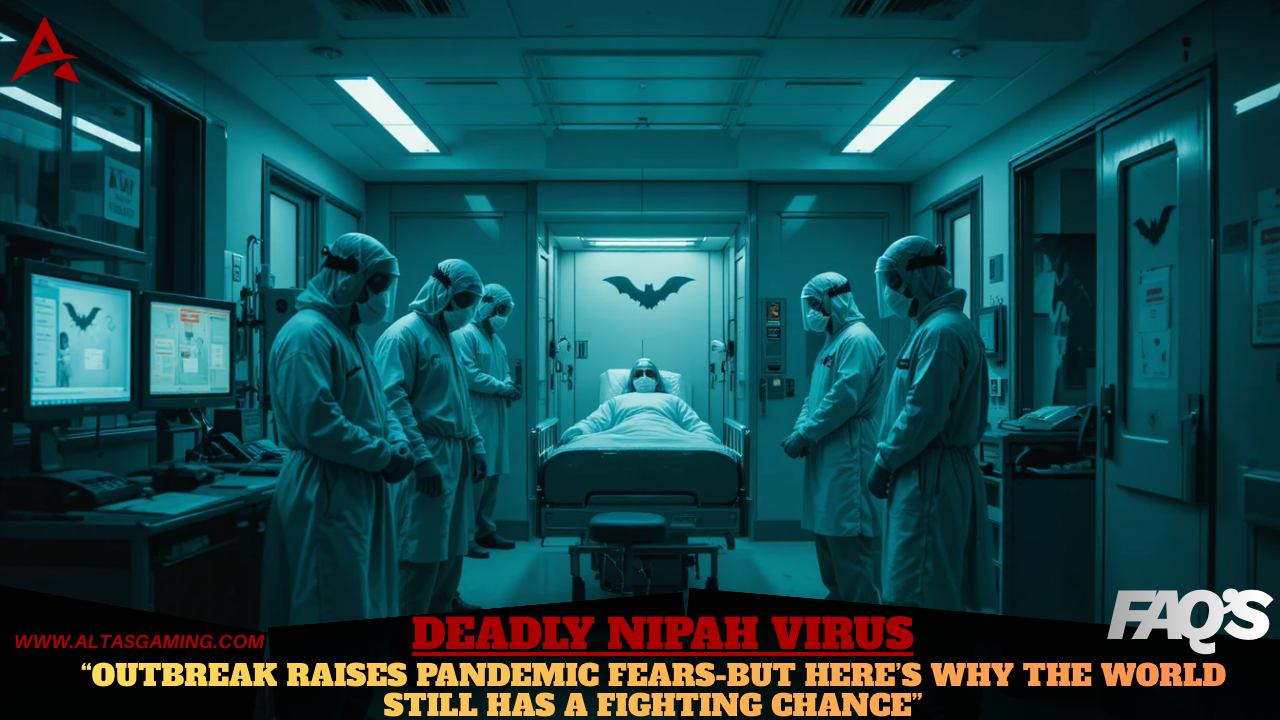
🦠 Deadly Nipah Virus Outbreak Sparks Global Alarm- No Cure, Rising Cases, and Fears of a New Pandemic
Health authorities across Asia are on high alert after officials confirmed a new outbreak of the deadly Nipah virus, a rare but extremely lethal pathogen with no known cure or widely available vaccine.
The outbreak has emerged in India’s West Bengal region, where at least five confirmed cases have been reported, including two nurses infected while treating patients at a hospital. Governments, scientists, and international health agencies are now racing against time to contain the virus before it spreads further.
The Nipah virus, transmitted primarily from bats to humans, has long been considered one of the world’s most dangerous emerging infectious diseases. Experts warn that its high fatality rate and potential for human-to-human transmission make it a serious global threat.
🚨 What Is the Nipah Virus?
The Nipah virus is a zoonotic disease (spread from animals to humans) first identified in 1998 in Malaysia. It is carried mainly by fruit bats and can infect humans through contaminated food, animals, or direct contact with infected individuals.
Key facts:
🧬 Fatality rate: 40%–75%
🦇 Primary source: Fruit bats
🧍 Human-to-human transmission: Yes
💉 Vaccine: None widely available
💊 Treatment: Supportive care only
Because of these factors, the World Health Organization (WHO) lists Nipah among pathogens with epidemic potential.
🇮🇳 India Outbreak- What We Know So Far
Authorities in India confirmed:
Five cases in West Bengal
Two nurses infected at a hospital
Several suspected cases under investigation
Hundreds of contacts being traced and tested
Hospitals have been placed under emergency protocols, and isolation wards have been activated.
Airports and border health authorities have begun screening travelers from affected regions to prevent cross-border spread.
🌏 Global Reaction- Asia on Alert
🇹🇼 Taiwan’s Emergency Move
Taiwan announced plans to classify Nipah virus as a Category 5 infectious disease, its highest alert level, allowing strict quarantine measures.
✈️ Passenger Screening
Several countries have started screening air passengers arriving from India, particularly those with symptoms like fever or respiratory distress.
🧪 Scientific Community Response
Virologists warn that climate change, urban expansion, and wildlife habitat destruction are increasing human exposure to bat-borne viruses.
🧠 Symptoms of Nipah Virus
Common symptoms include:
High fever
Severe headache
Vomiting and dizziness
Respiratory distress
Encephalitis (brain inflammation)
Coma in severe cases
Symptoms can appear within 4 to 14 days after exposure.
😨 What People Are Saying (Public Opinion)
The outbreak has triggered widespread anxiety on social media and among the public.
Many people fear:
A repeat of COVID-19-style pandemic
Government cover-ups
Lack of preparedness in healthcare systems
Others argue:
Nipah is less contagious than COVID-19
Outbreaks have historically been contained
Media coverage may be exaggerating risks
Public trust in health authorities is becoming a critical factor in managing the crisis.
🌍 Geopolitical Implications
The Nipah outbreak is not just a health issue it has geopolitical consequences.
Key impacts:
🔹 Travel restrictions could strain India’s economy
🔹 Regional tensions may rise over border health controls
🔹 Global supply chains could be disrupted if outbreak spreads
🔹 Governments may use health emergencies to justify stricter surveillance policies
Countries in Asia are quietly strengthening biosecurity measures, reflecting fears of biological threats in an era of rising geopolitical rivalry.
📊 Forecast- Will Nipah Become the Next Pandemic?
Experts say a global pandemic is possible but not inevitable.
Factors that could limit spread:
Lower transmissibility than COVID-19
Rapid contact tracing
Improved surveillance systems
Factors that could worsen the situation:
Mutation increasing transmissibility
Delayed response by authorities
Cross-border spread through travel
Healthcare system overload
If containment fails, Nipah could become one of the most dangerous outbreaks of the decade.
🧩 lta’s Opinion
The Nipah outbreak is a warning sign humanity cannot ignore.
Unlike COVID-19, Nipah has a far higher mortality rate. While it is less contagious, even a small mutation could change everything.
In my view, the real danger is not Nipah itself but global complacency.
Governments must act before panic spreads. Transparency, scientific cooperation, and early containment are the only ways to prevent disaster.
History shows that pandemics do not announce themselves they accelerate quietly until it is too late.
Nipah is not yet a global crisis, but it is dangerously close to becoming one.
❓FAQ’s (Deep & Rare Questions)
Q1: Could Nipah virus be weaponized?
While Nipah is naturally occurring, experts warn that any high-fatality virus raises biosecurity concerns, though there is no evidence of weaponization.
Q2: Why are bats linked to so many deadly viruses?
Bats have unique immune systems that allow them to carry viruses without getting sick, making them reservoirs for emerging pathogens.
Q3: Could Nipah spread through food or water?
Yes. Contaminated fruits or palm sap exposed to bat saliva have caused outbreaks in the past.
Q4: Is Nipah more dangerous than COVID-19?
In terms of mortality, yes. In terms of transmissibility, no.
Q5: Could lockdowns happen again?
Unlikely on a global scale unless human-to-human transmission increases significantly.
Q6: Are vaccines being developed?
Yes, but most are still in experimental stages and not widely available.
Q7: Why is Asia more vulnerable to Nipah outbreaks?
High population density, wildlife-human interaction, and tropical ecosystems increase exposure risks.
Uncompromising Performance for Demanding Gamers Dominate the latest AAA titles with the ASRock Radeon RX 9060 XT Challenger 16GB OC. Built on AMD’s RDNA 4 architecture, this GPU combines a blazing 3300 MHz Boost Clock and 32 Compute Units with 3rd Gen Ray Tracing + 2nd Gen AI acceleration for stunning visuals and intelligent performance. The massive 16GB GDDR6 VRAM (20 Gbps) effortlessly handles 4K textures and multitasking, while PCIe 5.0 ensures maximum bandwidth for next-gen gaming. Smart Cooling, Silent Operation Engineered for efficiency, the Challenger features a dual-fan design with optimized Striped Ring Fans and Ultra-fit Heatpipes that maximize thermal dissipation. The 0dB Silent Cooling technology halts fans during idle or light use, eliminating noise without sacrificing thermals. Protected by a rigid metal backplate and Military-Grade Super Alloy components, this card maintains peak stability even during marathon sessions. Ready for Tomorrow’s Gaming Equipped with HDMI 2.1b and DisplayPort 2.1a outputs, this GPU supports 8K/120Hz and 4K/240Hz displays for immersive gameplay. DirectX 12 Ultimate compatibility unlocks advanced ray tracing and AI-enhanced features. Whether you’re pushing high resolutions or streaming content, the RX 9060 XT Challenger 16GB OC delivers exceptional value with its future-proofed design and robust cooling.


 lta’s Opinion










Leave a Reply